
You have made the investment decision. The new electronic torque tools are in use, the software is running, the data is flowing. Everything seems to work - until the system shows its true nature.
Calibration? Only at the manufacturer or its authorized partners. Software update? Chargeable - and without the update, no current compatibility. Spare parts? Exclusively original, with a corresponding premium. Data export for your own quality software? Only in a proprietary format - importing into third-party software is not technically supported.
This is not an isolated case. It is the business model behind many closed screwdriving technology systems, from modular tool systems to complete production lines. And it has a name: vendor lock-in.
What is vendor lock-in in screwdriving technology?
Vendor lock-in means that critical business processes, data or interfaces are tightly coupled to a single provider. Switching later to an alternative solution involves significant technical, organizational and financial hurdles.
In screwdriving technology, this effect appears on several levels at once:
- Proprietary software: The evaluation software communicates exclusively with torque tools from the same manufacturer. Third-party solutions such as Ceus or QS-Torque are not integrated.
- Closed data formats: Tightening data cannot be exported into manufacturer-neutral formats. Analyses outside the ecosystem are technically blocked.
- Manufacturer-bound calibration: The tool must be calibrated exclusively by the original manufacturer or its partners - no competition, no alternative DAkkS calibration lab, no independent DAkkS calibration laboratory.
- Exclusive spare-parts ecosystem: Attachments, sensor modules and connectors are only available as original parts.
- Proprietary interfaces: Integration into existing MES, ERP or PLC infrastructure requires costly development effort because Open Protocol is not supported and no truly compatible interfaces are available.
Vendor Lock-in often sneaks in: At the start, a system seems attractive - rapid deployment, many features, all from one provider. Only after 2-3 years do the real costs become apparent: proprietary calibration, incompatible data formats, forced software upgrades. Then switching is expensive and time-consuming.
Vendor lock-in arises when a provider's products work at the customer site and are gradually supplemented by further products from the same provider. Manufacturers deliberately encourage this effect with proprietary technologies - their own formats, interfaces or protocols.
The subtle danger: in the first year, it is hardly noticeable. Dependency grows silently.
The hidden costs: TCO analysis over 5 years
The purchase price is what appears in the quote. The total cost of ownership (TCO) tells a very different story.
TCO quantifies all costs over the entire lifecycle of a product. It provides a far more accurate basis for evaluating an investment than the pure purchase price. In industrial screwdriving technology this difference is particularly significant - because a proprietary system is systematically designed to generate ongoing costs.
Direct cost drivers
1. Software licences
Mandatory annual licences for evaluation and parameterisation software add up to substantial amounts over five years. Since alternatives are technically locked out, there is no room for negotiation. To adapt the platform to specific requirements, companies often resort to expensive, vendor-specific solutions - which further drive up costs over time.
2. Manufacturer-bound calibration
According to DIN EN ISO 6789, torque tools must be calibrated at the latest after 12 months or 5,000 load cycles. In a closed proprietary system, only the manufacturer or its authorized partner may carry out this calibration - no price comparison, no competition. Since calibration is more expensive than routine verification, more and more companies are investing in their own calibration equipment and DAkkS calibration labs in order to reduce tool costs and increase availability. Anyone locked into a proprietary system cannot take this step.
3. Proprietary spare parts
The provider knows that its customer cannot easily switch - and steadily increases maintenance and replacement costs. For original spare parts without real market competition, markups of 20-40% compared to comparable standard components are common.
Indirect and opportunity costs
Lack of flexibility when processes change: If you change the product model or expand your assembly line, you are dependent on the manufacturer - custom configurations, compatibility updates and interface adaptations all show up on your invoice.
Dependency in supply bottlenecks: Companies that invest heavily in a proprietary system are not only dependent on the economic stability of the provider, but also on its product strategy, supply chain and the broader political environment.
Opportunity costs: You cannot deploy a better precision tool because it is incompatible with your existing software. You cannot use a more cost-effective DAkkS calibration laboratory because the manufacturer demands exclusivity. These costs never appear on a line item - but they are real.
Switching costs: Even if costs seem manageable at the beginning, the total escalates quickly: migration, training, consultants, legal review and temporary productivity loss during a system change often sum to six-figure amounts.
TCO comparison at a glance
| Cost type | Closed system | Open system (e.g. GWK) |
|---|---|---|
| Acquisition (tools, control) | Medium-High | Medium |
| Software license (annual) | Mandatory license, proprietary, no alternatives | Compatible with QuanLabPro, Ceus, QS-Torque (free choice) |
| Calibration (per year) | Only with the manufacturer or authorized partner | DAkkS-lab of choice - internal or external |
| Spare parts / accessories | Exclusively original parts, 20-40% surcharge | Modular quick-change square drive system - interchangeable parts |
| Integration into MES/ERP/PLC | Proprietary interfaces, high integration effort | Open protocol & PLC interfaces, plug-in capable |
| Flexibility in process changes | Low - vendor dependence for updates | High - tool independent of software ecosystem |
| Training when changing systems | Complete retraining required | Intuitive operation, minimal training effort |
| Total cost over 5 years (trend) | ⬆ Increasing dependency costs | ⬇ Decreasing lifecycle costs due to modularity |
Interactive TCO calculator: Calculate your specific case
Adjust the parameters to your situation - and see how closed vs. open systems develop over five years in a realistic numerical comparison and TCO analysis:
How to identify vendor lock-in: 5 checks before you invest
Before you decide on a system, a structured analysis of potential dependencies is worthwhile:
Can your screw data be exported to a manufacturer-neutral format (e.g., CSV, XML)? Or only to a proprietary system format? Missing export options are the first lock-in signal.
Who is allowed to calibrate your tools? Only the original manufacturer, or any DAkkS-accredited laboratory? An exclusivity arrangement for calibration permanently increases the cost and makes you dependent on the provider's availability and pricing.
Does the tool support Open Protocol and PLC interfaces? Or do you need the manufacturer's proprietary software to transfer data to your MES/ERP? The more closed the interface, the higher the integration effort with every system update.
Are attachments, sensor modules and connectors available only from the original manufacturer? Compare market prices with manufacturer prices — a systematic markup of 20-40% is not uncommon for proprietary systems.
What would a full system change cost - hardware, software migration, training, downtime? The higher this figure, the deeper the lock-in. Open systems keep these switching costs structurally low.
The open approach: What technical freedom means in practice
Open systems in screwdriving technology are not a theoretical alternative - they are an architectural decision that directly affects your costs, flexibility and control.
Open Protocol and PLC interfaces: Integration without dependency
Open Protocol is the established communication standard for electronic torque tools in the automotive industry. Tools with Open Protocol support transfer tightening data in real time to higher-level controllers, MES systems and ERP platforms - across manufacturers.
Open systems and open standards ensure universal compatibility and allow seamless integration with tools and services from different providers. They eliminate the restrictions of a proprietary system and its closed protocols and make it easier to adapt to changing business requirements.
Open data formats: Your data belongs to you
Tightening data is quality data. It must be freely available for audits, traceability and process analysis - not locked away in a vendor's proprietary system portal. Open systems export data in manufacturer-neutral formats that any quality software can further process.
This is not only a cost issue but also a compliance requirement: anyone who has to provide complete documentation for A-class screw joints according to VDI/VDE 2862 cannot afford data silos.
Freedom to choose your calibration provider: Competition saves money
According to DIN EN ISO 9001, regular calibration of torque tools is mandatory for certified companies. The decisive question is: are you free to choose the DAkkS lab? With open systems the answer is yes. DAkkS-accredited calibration is a competitive market - with open systems you can compare prices, use on-site services and optimise calibration cycles yourself.
Modular construction: Protecting your investment with component-level replacement
A modular tool system allows you to replace individual components independently. In screwdriving technology, that means: only the worn or adapted part is exchanged - not the entire production tool.
GWK as an example of open system architecture
GWK has made a deliberate decision in favour of an open system philosophy in its precision tools. This is not marketing jargon - it comes down to specific technical specifications that make your day-to-day work easier.
OPERATOR® production tool
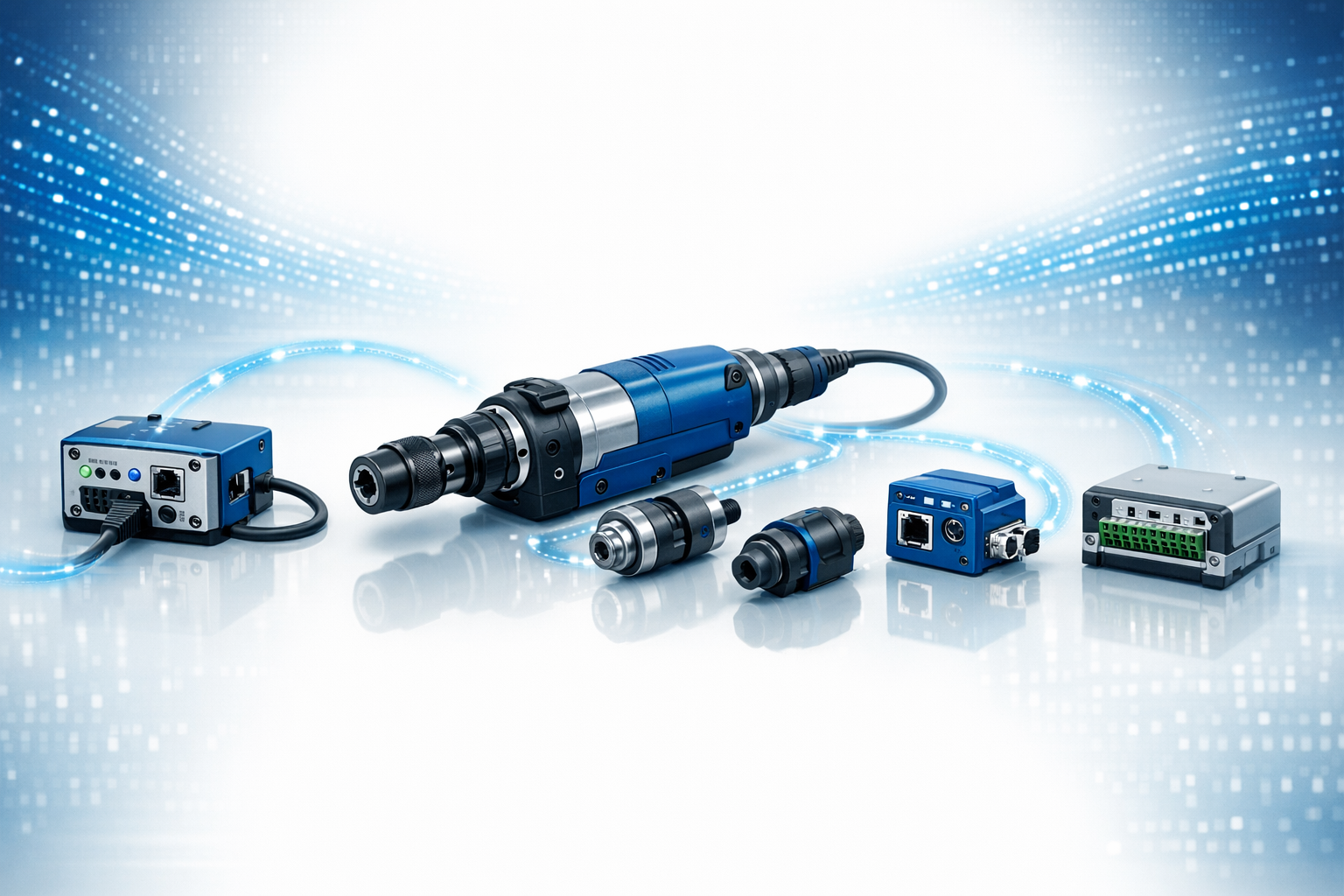
The OPERATOR® production tool supports Open Protocol as well as PLC interfaces for bidirectional coupling with production systems - including Siemens and Beckhoff PLC architectures via TCP/IP, RS232 and RS422. WLAN data transmission sends all tightening data in real time into your existing IT infrastructure, without proprietary middleware.
The modular square-drive change system is the structural core of the OPERATOR® production tool: individual attachments and torque heads are swapped, the base tool remains. When production changes or a new torque range is required, you invest in a single component - not an entirely new device. This modular construction reduces follow-on costs structurally and turns the OPERATOR® into a flexible, modular tool system.
For production managers who want to secure their line in accordance with the standards, our decision guide for standard-compliant screwdriving tools provides a systematic overview of tool requirements for each screw joint class.
QUANTEC MCS® analysis tool
The QUANTEC MCS® analysis tool with its floating-point angle measurement without fixed reference is the heart of screwdriving process analysis in development and quality assurance. The robust aluminium-titanium design ensures a measurement accuracy of ±1% between 10 and 100% of the nominal range - even after years of intensive use.
Crucial for openness: the QUANTEC MCS® is compatible with QuanLabPro, Ceus and QS-Torque - the established quality data systems in the industry. You do not have to introduce an entirely new software environment. You continue to use what you already know. The QUANTEC MCS® integrates into your existing documentation infrastructure for screwdriving processes without forcing additional proprietary software.
DAkkS calibration laboratory without exclusivity
GWK operates its own DAkkS-accredited calibration laboratory with the DWPM-1000® fully automatic test machine with accuracy class 0.2 - for maximum calibration accuracy on torque and angle tools. In addition, mobile calibration services at your site minimise transport risks and tool downtime.
The key difference from the lock-in model: GWK does not require you to use its DAkkS calibration lab exclusively. You can have GWK tools calibrated by any DAkkS-accredited laboratory. That is structural freedom - not just an optional service.
GWK ToolRent®: Avoiding capital lock-in without provider dependency
The GWK ToolRent® tool rental system eliminates another lock-in trap: capital tied up through high investment costs. Calibrated devices are available on a weekly, monthly or annual basis - shipped worldwide, without long-term dependence on a single manufacturer.
For project runs, seasonal peaks or prototype phases, this is not only economically attractive; it also protects you from strategic misinvestments in proprietary systems that later reveal themselves as vendor lock-in.
Conclusion: The cheapest decision is not the lowest purchase price
When you buy a torque tool, you are effectively buying a system - with software, calibration services, spare parts, interfaces and integration into your MES interface and ERP environment. And you are committing yourself for many years, sometimes decades, to the architecture of that system.
In production technology, the total cost of ownership of a system over five years regularly exceeds the pure purchase costs. In closed, proprietary system landscapes this effect is even stronger due to deliberately created dependencies: software licences, calibration monopolies, mandatory original spare parts and integration effort all add up to real cost disadvantages.
Vendor lock-in can rarely be eliminated entirely, but it can be significantly reduced. The decisive factors are open systems with compatible interfaces, clean data models, documented processes and a realistic exit strategy.
Open systems offer exactly that: compatibility with existing software, freedom to choose your calibration provider, modular construction with exchangeable components and standardised protocols such as Open Protocol. In the long term, the winner is not the loudest vendor - but the one who leaves you with the greatest freedom.
Frequently asked questions about vendor lock-in in screwdriving technology
What is vendor lock-in in screw technology?
Vendor lock-in refers to dependence on a single manufacturer because their proprietary technologies - software, data formats, interfaces, calibration - make switching providers technically and financially more difficult. In screw technology, this becomes evident in manufacturer-specific calibration, closed data formats, and incompatible software platforms.
What hidden costs are incurred by a proprietary screw system?
In addition to the visible license fees, there are opportunity costs (no better alternative tools available), additional costs for original spare parts (often 20-40% markup compared to market), forced manufacturer calibration without competition, as well as high migration costs in the event of a possible system change.
What does Open Protocol mean for screw tools?
Open Protocol is an established communication standard in the automotive industry that allows screwdriving tools to communicate directly with higher-level controllers, MES, or ERP systems - regardless of manufacturer. Tools with Open Protocol can be integrated into any standard-compliant production environment.
Can I use GWK tools with my existing software?
Yes. OPERATOR® supports Open Protocol and PLC interfaces for integration into all common production systems. The QUANTEC MCS® analysis tool is compatible with QuanLabPro, Ceus, and QS-Torque. GWK tools integrate into existing quality and manufacturing infrastructures without replacing your existing IT stack.
Do I have to calibrate at the GWK laboratory?
No. GWK operates its own DAkkS-accredited calibration laboratory and also offers mobile calibration services—without requiring exclusive use. Since GWK tools are open systems, you can commission any DAkkS-accredited laboratory for calibration.
What is the quick-change square drive system and how does it reduce costs?
The modular quick-change square drive system of the OPERATOR® allows swapping individual components — attachments and torque heads — without having to replace the base tool. In production changes or wear, only the affected parts are replaced, which significantly reduces investment and follow-up costs.