You have already classified your screwdriving applications according to VDI/VDE 2862 - good. Now comes the decisive question: Which screwdriving tools do you actually need to use? And what is genuinely sufficient - for which category and in which situation?
This guide answers exactly that. Not in abstract terms, but with the kind of practical detail that manufacturing engineers, quality managers and purchasing teams need: clear requirements for each category, an easy-to-read decision matrix, and an honest reminder that the right tool selection alone still does not guarantee a fully standard-compliant process.
What the standard really requires - and what it leaves open
VDI/VDE 2862 defines application classes for torque fastening and minimum requirements for screwdriving tools - and provides the framework to select suitable screwdriving tools so that torque fastening in production is safe and reliable.
What the guideline explicitly does not specify is which exact tool must be used. The minimum requirements are generally valid and solution-agnostic - they are not tied to particular system architectures, fastening concepts or assembly technologies.
That may sound like flexibility. In practice, it means responsibility: you must ensure yourself that the screwdriving tools you choose actually meet the required characteristics. When it comes to product complaints and product liability, companies must demonstrate that they have worked in line with the state of the art - and anyone who can prove they have followed VDI/VDE 2862 has already taken a major step in the right direction.
The standard does not prescribe a tool - it defines properties. VDI/VDE 2862 provides you with solution-independent minimum requirements: Which measurement quantities must be recorded? Must fault shutdown be performed? Is component identification necessary? Only after these questions have been answered can the correct tool selection be made.
The decision matrix: requirements by category at a glance
Before we look at the individual categories, here is a direct overview of the key requirements and the matching GWK solutions - a compact decision matrix for tool selection and screwdriving tools:
| Requirement / Characteristic | Category A (safety-critical) | Category B (functional-critical) | Category C (non-critical) |
|---|---|---|---|
| Risk level | ⚠️ Safety & Environment | ⚙️ Functional failure | ℹ️ Customer satisfaction |
| Tool type | Electronic, measuring & controlling | Electronic, measuring | Mechanical or electronic |
| Measurement quantities | Torque AND angular displacement | Torque (+ optional angle) | Torque (basic requirement) |
| Data documentation | 100% traceable, every screw | Systematic, by sampling | Recommended, not mandatory |
| Component identification | ✅ Mandatory (e.g., barcode scanner) | ⚡ Recommended | ❌ Not required |
| Faulty screw fastening detection | ✅ Automatic & immediate locking | ✅ Detectable & documented | ⚡ Sampling-based |
| MFU (Machine Capability) | ✅ Mandatory, regularly | ✅ Mandatory, regularly | ⚡ Recommended |
| PFU (Process capability) | ✅ Mandatory (Cpk/Cmk ≥ 1.67) | ✅ Mandatory (Cpk/Cmk ≥ 1.33) | ❌ Not required |
| Calibration | DAkkS-traceable, short intervals | DAkkS-traceable | Regular tool inspection |
| Recommended GWK tool (Production) | OPERATOR® + Barcode + IT integration | OPERATOR® Line assembly | Calibrated tool |
| Recommended GWK tool (QA / Analysis) | QUANTEC MCS® Analysis tool | Q-CHECK® tool inspection | Q-CHECK® inspection |
Category A: Safety-critical - no room for compromise
Screwdriving applications are classified according to the risk posed by a failure and how easily a faulty connection can be detected. Category A applications carry a risk to life, limb and the environment. Typical examples include brake calipers, steering components, structural joints in aerospace, or safety-relevant connections in pressurized systems.
For a safety-critical torque fastening of Category A, the guideline requires that all fastening data be available. In this context, in addition to data documentation, it can also make sense to use part identification or automated error detection.
In practice, this means: no leeway. Every single fastening must be monitored, documented and fully traceable. Faulty connections must be detected automatically and the part must be locked out.
What Category A tools must be able to do
- Measurement of torque AND angle - both values are needed for a complete torque fastening curve analysis, often using an integrated angle gauge and torque meter
- 100% documentation of every individual fastening, not just random sampling
- Part identification - for example using an integrated barcode scanner, so each screw can be assigned to a specific part for full production traceability
- Automatic error detection with a lockout signal: NOK fastenings must not leave the station
- IT integration for seamless traceability, data logging and audit-ready documentation
GWK solution for Category A
In production: OPERATOR® with barcode scanner and IT integration
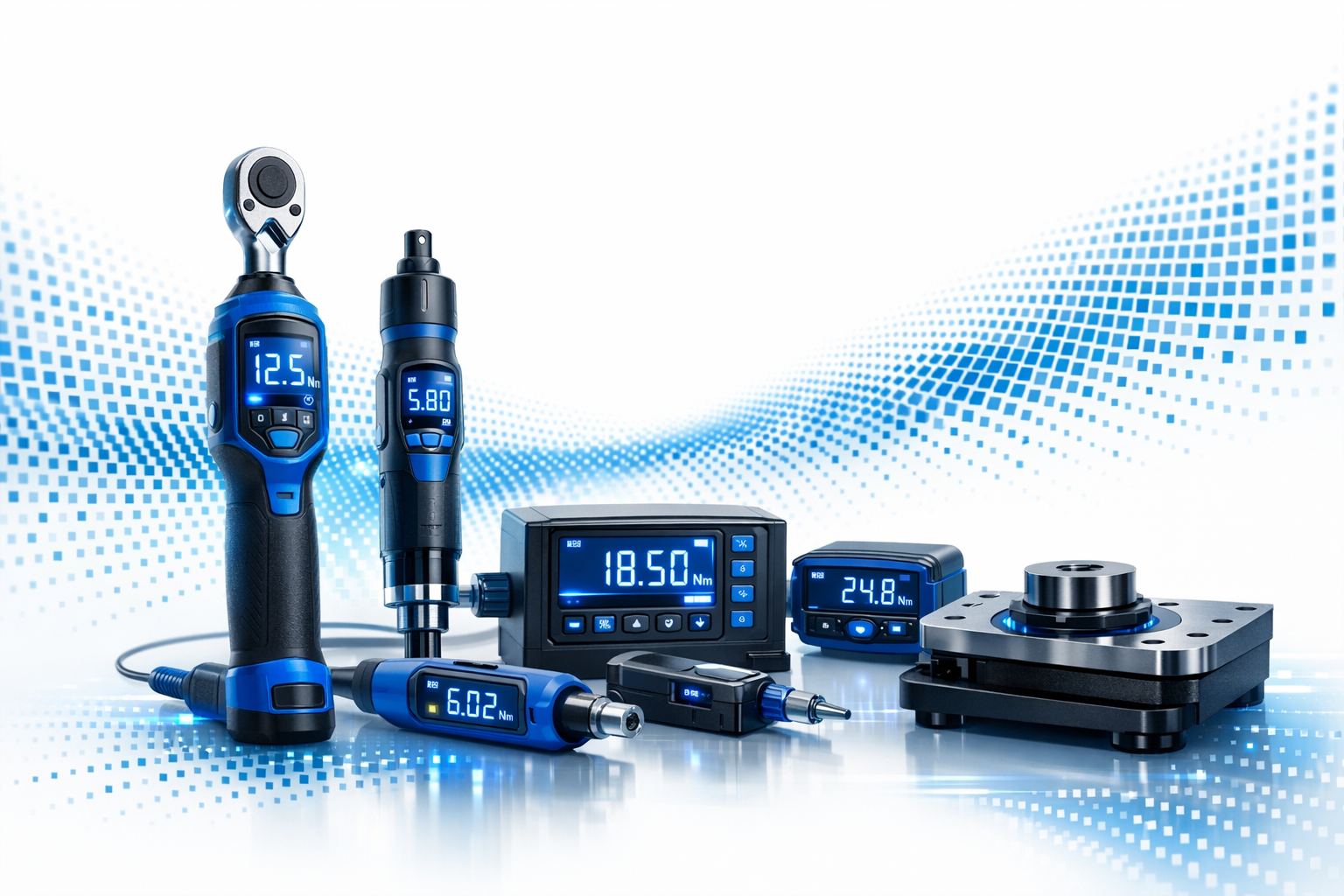
The OPERATOR® from GWK is modular in design and can be equipped with an integrated barcode scanner as well as interfaces to your production IT systems. Its interchangeable square drive system (square drive interface) offers maximum flexibility for changing fastening tasks - without having to replace the base tool.
Wireless data transmission (WLAN) ensures that all fastening data is transmitted in real time to your IT systems - providing the end-to-end production traceability that Category A requires.
For analysis and quality assurance: QUANTEC MCS® analysis tool
The QUANTEC MCS® with non-fixed-point angle measurement enables real-time monitoring of screwdriving processes and precise analysis of threaded fastenings - essential for process capability studies (PFU) and validation of your Category A processes. The modular design with titanium tubes ensures long-term accuracy even under tough production conditions during torque fastening.
The quantec mcs analysis solution is widely used as part of a modular tool system for demanding torque tools and torque fastening applications.
Category B: Function-critical - systematic, but scalable
Category B applications carry a risk of functional failure - in the automotive industry these are the classic roadside breakdowns. Transmission, engine or axle joints are frequently assigned to this category.
The requirements are clearly lower than for Category A, but still significantly above the minimum. Electronic, measuring torque tools with data acquisition and systematic documentation are mandatory. The key difference from Category A: complete individual documentation of every single screw is not strictly required; robust, statistically sound sample documentation is sufficient.
What Category B tools must be able to do
- Electronic, measuring screwdriving tool - purely mechanical tools are not sufficient for Category B
- Torque measurement as a minimum requirement, angle measurement recommended
- Systematic data documentation to ensure auditability
- Regular machine capability tests (MFU) according to VDI/VDE 2645
- Process capability proof (PFU) with Cpk/Cmk ≥ 1.33 as a minimum requirement
GWK solution for Category B
On the assembly line: OPERATOR®
The OPERATOR® also covers Category B applications - in the standard configuration without barcode scanner, but with full electronic data capture and wireless transmission. The modular square drive system makes it flexible for different screw sizes and torque levels.
For regular tool testing and MFU: DWPM-1000 calibration unit in combination with Q-CHECK®
Q-CHECK® serves as a precise measuring device for evaluating and monitoring your production screwdriving tools and is used together with the QUANTEC MCS® for process capability studies (PFU). For machine capability studies (MFU), the DWPM-1000 calibration unit is used.
Together, these solutions support systematic tool calibration and tool selection in line with VDI 2862 and VDI/VDE 2645, ensuring your torque meter and torque tools remain within specification.
Category C: Non-critical - but not uncontrolled
Category C applications include all screw joints that are neither A nor B. They are commonly labelled "non-critical" - previously also described as "customer-critical", since a failure may annoy the customer at worst but does not affect safety or essential function.
Still, the following applies: anyone who uses simple pneumatic screwdrivers to tighten screws and has not implemented suitable test processes will struggle to prove, in the event of a complaint, that assembly was performed in line with the state of the art - and may be held liable. Even for Category C, you must ensure a basic level of accuracy for your screwdriving tools.
GWK solution for Category C
Calibrated torque tools with regular verification using Q-CHECK® - this is sufficient to work in compliance with the standard and provide the necessary evidence. Complete individual documentation of every fastening is not required; however, sample-based checks are recommended.
Interactive: Which tool fits your situation?
Use our decision finder to identify the right GWK solution for your specific application in just a few clicks - whether for production, quality assurance or calibration:
Why tool choice alone is not enough
This is where a common misconception arises: a company purchases tools that it believes are standard-compliant - and assumes that this alone means VDI/VDE 2862 is fulfilled. In practice, that is not enough.
In addition to the minimum requirements for screwdriving tools, VDI/VDE 2862 also calls for verification of the production process itself. This includes, among other things, demonstrating the suitability of the tool in line with its application class. Proving this suitability requires three elements that must interact:
1. Calibration - DAkkS traceable and regular
Screwdriving tools drift over time. Even high-quality electronic tools lose measurement accuracy without regular tool calibration. For Categories A and B, a DAkkS-accredited calibration with traceability to national standards is the established industrial standard.
GWK operates its own DAkkS accredited calibration laboratory - and also provides a mobile calibration service, where the GWK team comes directly to your production facility for on-site calibration. This saves shipping time and prevents production downtime due to missing tools.
2. Training - understand the standard, master the tool
Your staff must understand the requirements of the standard and be able to operate the systems correctly - regular training is essential. An incorrectly configured electronic tool can still produce NOK joints that go undetected, even if the right tool selection was made.
3. Process integration - use the data, do not just collect it
The tool provides data - but only systematic analysis creates process reliability. For Categories A and B, this means: integration with your production IT, analyzable reports and regular process capability studies (PFU) according to VDI/VDE 2645-3. QUANTEC MCS® is compatible with analysis software such as QuanLabPro, Ceus or QS-Torque and integrates seamlessly into existing quality management systems.
Tip: Tool selection and calibration go hand in hand. The best production tool is of little use if it is not calibrated regularly and in compliance with standards. Plan calibration cycles from the outset in your process planning — ideally with a DAkkS-traceable proof.
Stay flexible: the modular square drive system and ToolRent®
Not every production environment has a constant need for tools. For project-based use, ramp-up phases or a one-off process capability study, GWK offers the ToolRent® rental system: all rental devices are calibrated before shipment, ready to use immediately and supplied with a calibration certificate - without capital investment when demand is infrequent.
The modular square drive system of the OPERATOR® also makes your investments future-proof: instead of buying new tools whenever torque levels or screw sizes change, you simply swap the square drive adapter. This saves costs, simplifies calibration logistics and reduces the variety of tools in stock.
This modular tool system is particularly attractive for companies that frequently adapt their torque fastening strategies and want to keep screwdriving tools standardized across several lines.
Decision aid: which GWK tool for which requirement?
| Requirement | Recommended GWK tool |
|---|---|
| Category A production with full traceability | OPERATOR® + barcode scanner + IT integration |
| Category B assembly line | OPERATOR® Standard |
| Torque curve analysis & PFU execution | QUANTEC MCS® analysis tool + Q-CHECK® |
| MFU & tool verification | DWPM-1000 calibration unit |
| On-site calibration without production downtime | GWK mobile calibration service (DAkkS) |
| Project-based / temporary tool demand | GWK ToolRent® rental system |
| Flexible torque ranges on a single line | OPERATOR® with square drive system |
Conclusion: compliance comes from the system - not from the tool alone
Choosing the right screwdriving tools is the first and most important step - but it is only one of several. Those who fasten according to current standards and guidelines such as VDI 2862 and VDI/VDE 2862 are on much safer ground in the event of damage or liability claims. Beyond that, consistent standardization in tool selection, torque fastening strategies and test processes improves product quality and internal workflows: it makes production more efficient and reduces downtime to a minimum.
GWK provides you with a complete system solution from a single source: from tool selection and configuration, through DAkkS accredited calibration in the DAkkS accredited calibration laboratory, all the way to process integration and staff training. Engineering with Passion at GWK means this: together with you, we develop the optimal solution for your specific requirements - not an off-the-shelf package.
Do I need to use calibrated tools for category-C screw assemblies?
Yes - even for category C, VDI/VDE 2862 requires a basic accuracy of the tools used. However, here regular inspections (e.g., with the Q-CHECK®) are sufficient without requiring exhaustive per-fastener documentation. Important: Even for non-critical connections, you are obliged in the event of a fault to prove compliance with the state of the art.
What is the difference between MFU and PFU—and which tool do I need for them?
The MFU (Machine Capability Study) tests the screw tool itself: Is it sufficiently accurate and repeatable? For this, the calibration device DWPM-1000® is used. The PFU (Process Capability Study) evaluates the entire screwing process under real conditions — here the QUANTEC MCS® for screw image analyses and real-time monitoring, and the Q-CHECK® as a QA and audit tool for precise subsequent torque measurements are used.
Can I use the same tool for category-A fastenings as for category B?
Only if it meets the additional category-A requirements: complete data capture (torque AND rotation angle), automatic fault detection with a locking mechanism, and component identification (e.g., barcode scanner). The OPERATOR® is modular in design and can be fitted with these features - please contact us for the appropriate configuration.
How often do screw tools need calibration?
That depends on category, operating conditions, and manufacturer requirements. As a rule of thumb: the higher the screw category, the shorter the calibration intervals. For category A, annual or shorter intervals with a DAkkS-traceable certificate are typically standard. Our mobile calibration service comes directly to your production site - without downtime due to tool shipping.
Is a rental system like GWK ToolRent® worth it - or should I buy?
ToolRent® pays off especially for project-based needs, start-up projects, audit preparation, or when you only temporarily need a tool for a PFU. All rental devices are calibrated before delivery and are ready to use immediately - including a calibration certificate. For sustained needs in mass production, purchasing is generally recommended.