
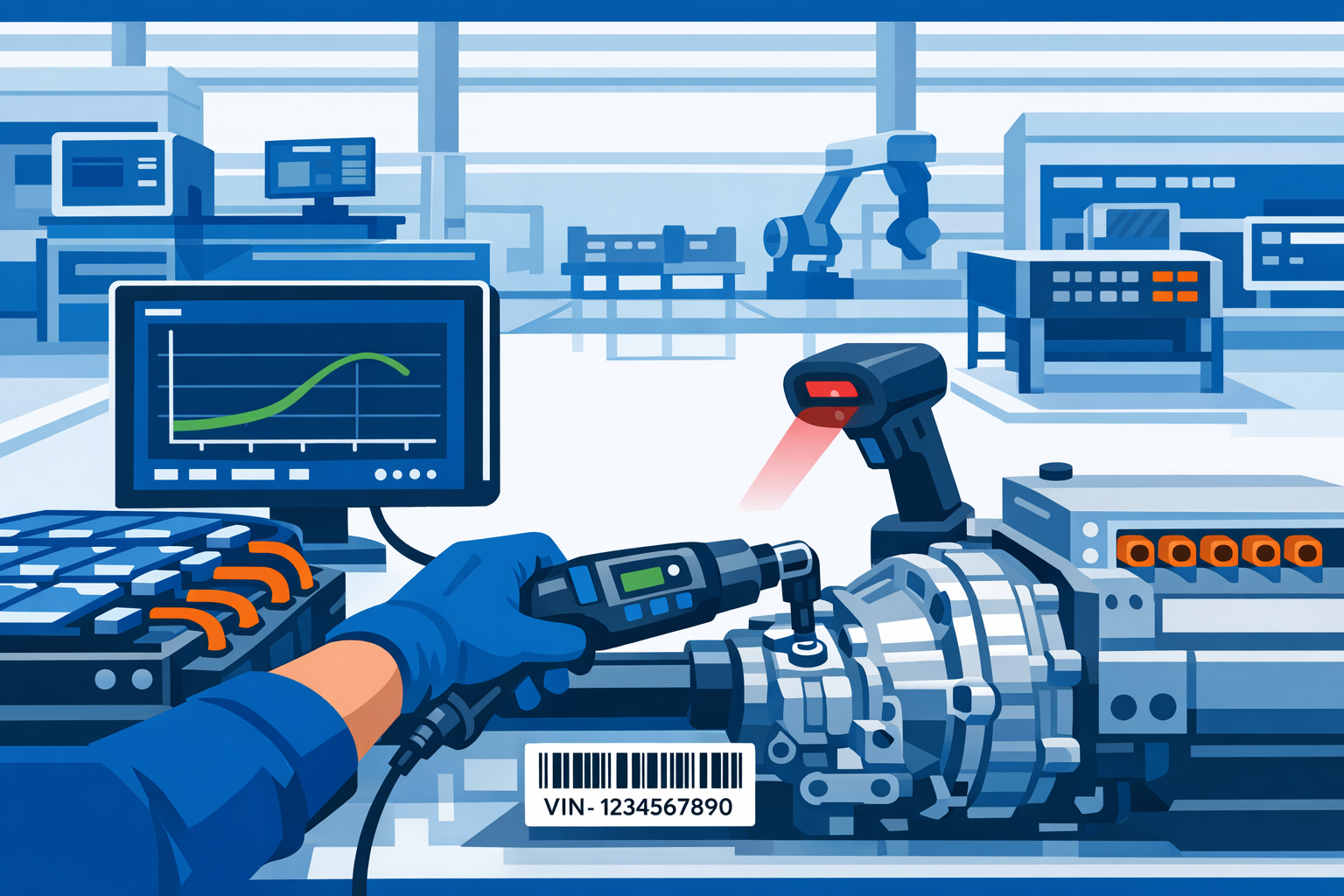
Electric vehicles have elevated torque from a mechanical parameter to a key element of functional safety. This article explores insights from leading EV programs in battery, e-axle, and inverter assembly, highlighting how calibrated torque tools, specialized software, and VIN-level traceability create a strong foundation for global and US manufacturing.
Key Findings at a Glance
- EV battery systems are the most expensive car subsystem, often representing 30-40% of total vehicle cost. Every safety-critical fastener is a direct business and safety risk if torque or traceability are lacking.
- A typical EV chassis uses 300-500 fasteners; 60-100 may secure the battery frame to the chassis. Many are top safety class joints requiring documented torque and angle for each screw.
- Modern packs contain 2,000-8,000 cells and store 50-100 kWh. High-voltage busbars and terminals are highly sensitive to clamping force; under-torque can increase contact resistance by 30-50%, causing local overheating.
- Compact e-axles integrate motor, gears, and often power electronics in one housing at 400-800 V and thousands of newton-meters of torque. Dozens of internal fasteners become safety- and NVH-critical.
- Traceability requirements are rising; many OEMs now require a complete tightening record for each safety-critical joint, linked to VIN and component ID via barcode systems, data matrix, or RFID.
- For this control level, calibrated electronic torque tools, software like QUANTEC MCS, Q-CHECK, FTS 1000, and a robust calibration service, including on-site calibration, are essential parts of the EV safety concept.
Battery Packs: Torque as the Backbone of Functional Safety
Treat battery fasteners as safety-critical hard joints
EV batteries' high voltage and energy content mean every structural and high-voltage fastener must be treated as safety-critical. In practice:
- Classify pack-relevant screw joints (pack-to-chassis, module-to-tray, cover seals, HV terminals, crash structures) in the highest safety class.
- Design tightening strategies assuming most joints are hard (minimal post-snug rotation), requiring tight torque and angle tolerances.
- Use torque-plus-angle or yield-based strategies for heavily loaded fasteners and busbars, not just torque-only methods which are more sensitive to friction.
- Validate residual torque and clamping force with tools like QUANTEC MCS during launch and periodically in series production to ensure theoretical values deliver required clamp load under real conditions.
EV program data shows battery frames can use 60-100 bolts just to mount a pack, often M10-M12 high-strength grades, with defined sequences to control distortion. Inside the pack, busbars and modules add critical joints influencing electrical and mechanical performance.
Electronic torque/angle tools and systems offer the repeatability and documentation these safety joints require. Portable solutions like QUANTEC MCS help analyze joint behavior, optimize torque/angle, and set control limits before rollout to production tools.
Make traceability down to the VIN non-negotiable
Once a tightening strategy is set, the next challenge is proving-years later-that every critical screw was tightened properly. Battery assembly traceability must cover:
- Vehicle level: Link each tightening for safety-critical joints to the VIN.
- System level: Link results to battery pack ID, module IDs, and key components (e.g., power module serial numbers).
- Process level: Tie measured values to specific tool, program, operator, tightening curve, and timestamp.
Automated stations use PLC-integrated controllers and software as part of the tightening system. For manual stations and rework, connected torque tools can capture results wirelessly to a central database.
Key technology elements:
- Barcode integration: OPERATOR tools with built-in scanners and interchangeable drives let operators scan VINs, module barcodes, or work orders before tightening. Each measurement is linked without slowing the process.
- Flexible measurement/analysis: QUANTEC MCS and MCS MULTIBOX capture multiple tightening curves for central analysis, informing work instructions and control limits.
- Shop-floor verification: Q-CHECK systems verify torque tools daily or per shift ensuring accuracy between calibrations.
- Data handling: Secure data transmission to a central database, plus structured data analysis, supports audits, investigations, and ongoing quality improvement.
For EV plants expanding or scaling in the US, establishing this traceability backbone-including barcode systems, IT integration, and naming conventions-early saves significant effort as volumes and compliance needs grow.
E-Axles: High Power Packed into a Single Housing
Engineer torque strategies for integrated motor-gearbox-inverter units
An e-axle integrates electric motor, reduction gearbox, and often power electronics into a compact unit delivering hundreds of kilowatts and thousands of newton-meters. Because so much is concentrated in one housing, any torque deviation has a significant impact on durability, NVH, and safety.
Key screw cases include:
- Stator housing and end-shield bolts, affecting alignment and bearing preload
- Gearbox housing, bearing caps, and cover screws, which control gear mesh and noise
- E-axle to subframe mounting, transmitting crash loads and road inputs
Drive motor and reducer assemblies may use 50-80 high-strength fasteners with tight torque windows (e.g., ±3-5%). Errors can cause gear whine, bearing failure, leakage, or housing cracks.
A structured torque concept should:
- Define structural joints, those influencing gear mesh/bearing preload, and HV path joints
- Use torque-angle strategies where stiffness changes rapidly (e.g., bearing cap bolts) for better seating detection
- Monitor angle to catch cross-threading, missing parts, or trapped components in real time
Use connected torque tools to capture every critical operation
Not all e-axle steps are automated. Many OEMs and Tier-1s use manual stations for variants, rework, and low-volume lines. To maintain consistent traceability across all stations, manufacturers rely on hand-held, connected tools and mobile measurement systems.
Key solutions:
- OPERATOR and OPERATOR EST01 tools with electronic torque/angle measurement, barcode scanner, and programmable programs. Integration with PLC or MES logs each tightening against VIN and station.
- QUANTEC MCS MULTIBOX monitors several channels at once-ideal for complex end-of-line checks with multiple joints.
- FTS 1000 offers a mobile measurement and verification station, letting engineers validate torque programs or perform capability studies at the line.
Localizing e-axle production in the US? This approach keeps a consistent tightening standard-using the same measurement concepts, with Germany-origin calibration and repair services, deployed and audited in US plants.
Inverters and High-Voltage Busbars: When Torque Becomes an Electrical Parameter
Control electrical performance through mechanical torque
For inverters and high-voltage distribution, torque directly influences electrical performance. High-voltage busbars and power modules rely on defined clamping force for low contact resistance and stable thermal behavior.
HV busbar design studies show:
- Contact resistance depends on torque, surface finish, and plating
- Under-torqued joints can increase resistance 30-50%, causing heating and insulation aging
- Guidance is to preload joints to a fraction of yield strength, using controlled two-step tightening (pre-torque and final torque)
Improper torque can lead to increased I²R losses, hot spots, corrosion, sensor drift, or insulation breakdown.
For these joints, the tightening system must be treated as part of the electrical design, including:
- Using torque-angle control for consistent clamp across busbar stacks
- Monitoring tightening curves for anomalies (double seating, contamination)
- Defining residual torque check procedures with high-precision tools like QUANTEC MCS for audits
Standardize 100% traceable tightening on all HV joints
As high-voltage joints are extremely safety-critical, most OEMs require 100% traceability-even beyond battery pack mounts. This impacts inverter and HV box assembly lines:
- Every HV connection (DC link, phase outputs, charging inlets, fuses) is tightened with capable electronic tools recording torque and angle
- Barcode or DMC readers link each tightening to the specific power module, busbar, and inverter housing (simplified by OPERATOR tools with scanners)
- Data transfers wirelessly to a central database, stored with process data (e.g., high-voltage tests), supported by robust IT integration and secure data transmission
- Analysis software (e.g., QUANTEC MCS data) supports trend monitoring, automated alarms, and fast root-cause analysis on failures
Standardizing data structures and traceability across global plants-including new US operations-reduces complexity and streamlines audits and homologation.
Calibration, Service and Custom Tooling: The Hidden Backbone of Torque Traceability
Build a calibration strategy around EV-specific screw joints
Even the best tightening concept fails if measurement equipment isn't reliable. EV powertrain programs require a calibration and service strategy tailored for safety-critical joints.
Best practices include:
- Setting calibration intervals by risk: monthly/quarterly Q-CHECK verifications for safety-critical joints; 6-12 months full calibrations for production tools, based on usage
- Using reference systems like QUANTEC MCS and FTS 1000 as the torque standard, aligned with national standards
- On-site calibration (kalibrierung vor ort) on high-volume lines to reduce downtime and logistics, especially in dispersed plants
- Pairing calibration with preventive repair and functional checks, so tools return with proven performance
A strong calibration service offering both lab and on-site support gives manufacturers documented assurance every measurement device is traceable and within tolerance.
Support global and US expansion with mobile services and flexible tooling
European and Asian EV OEMs expanding in the US face three main torque and traceability challenges:
- Harmonizing tightening concepts and torque levels across regions
- Meeting global standards and local compliance for measurement, calibration, and documentation
- Scaling quickly during ramp-up without overinvesting in tools that may become underutilized
A champion in electronic torque and angle technology, with 100% Germany-based R&D, production, and calibration, can address these via:
- Mobile calibration teams and partners deliver on-site calibration in the US, matching European standards
- Tool rental options like ToolRent support ramp-ups and pilot lines with temporary access to OPERATOR tools, QUANTEC MCS, or FTS 1000
- Custom fixtures ensure measurement and tightening gear fits each platform's geometry and ergonomics
- Robust software and interfaces enable smooth IT integration with MES, ERP, and quality systems, maintaining data consistency across continents
The result: a globally consistent torque and traceability system, from pilot builds in Europe to US mass production, without sacrificing safety or efficiency.
From Concept to Implementation: Conclusion and Next Steps
Torque and traceability in EV powertrain assembly are now central design parameters for batteries, e-axles, and inverters, directly affecting safety, warranty, and brand reputation.
To move from theory to practice, EV manufacturers and Tier-1s should:
Map all EV-specific screw cases
- List joints in battery, e-axle, and inverter assembly
- Classify by safety, electrical impact, and joint type (hard/soft)
Define tightening and verification by joint family
- Choose torque-only or torque-angle strategies
- Set capability targets and verification (e.g., periodic residual torque audits with QUANTEC MCS)
Design traceability early
- Decide required tightening data (VIN, part ID, tool ID, curve, timestamp)
- Specify barcode systems, scanner needs, and IT integration
Build a calibration and service plan
- Set intervals and responsibilities for verification, calibration, and repair
- Use on-site calibration (kalibrierung vor ort) to cut downtime
Pilot, analyze, and scale
- Use Q-CHECK, QUANTEC MCS, and FTS 1000 to collect real tightening data in pilots
- Analyze data to refine limits and work instructions before scaling to new plants and regions
Manufacturers integrating hardware, software, calibration, and data into a unified torque and traceability system will be best positioned for safe, reliable, and cost-competitive EV powertrain production at scale.
Frequently Asked Questions about Torque and Traceability in EV Powertrain Assembly
How is torque control in EV powertrains different from conventional ICE vehicles?
In ICE powertrains, torque control matters for durability, emissions, and NVH, but a fastener drifting out of tolerance usually causes gradual issues. In EV powertrains, safety-critical joints surround high-voltage and energy storage. A single under-torqued busbar bolt can spike contact resistance, cause local overheating, and even trigger a thermal event.
EV architectures also concentrate more critical joints. Key functions are bundled into battery packs and compact e-axles, making each fastener more critical and requiring 100% documented tightening, not just sampling.
What does "traceability down to the VIN" mean in practice?
Traceability down to the VIN means you can reconstruct-years later-what occurred on any specific vehicle. This requires tightening data to include:
- VIN and relevant IDs (e.g., battery pack or e-axle serial)
- Tool and program ID, target torque/angle, and limits
- Measured values (torque, angle, status, tightening curve as needed)
- Timestamp, station ID, and operator ID if needed
Barcode scanners on tools and stations reliably capture this information, linking scanned IDs to each tightening result and transferring it via secure data connections to your quality database.
How often should torque tools be calibrated in EV assembly, and can it be done on site?
There's no single rule, but a risk-based approach is recommended:
- Daily/shift: quick checks against a reference device like Q-CHECK for high-risk joints
- Every few months: verification with high-precision systems like QUANTEC MCS or FTS 1000
- Annually or by cycle count: full calibration of internal sensors in a lab
On-site calibration (kalibrierung vor ort) is ideal for large plants or multi-shift lines, letting mobile calibration services bring reference gear to the line to minimize downtime and logistics and avoid mix-ups.
Can systems like QUANTEC MCS, Q-CHECK, and FTS 1000 integrate with existing MES or ERP?
Yes. Modern torque measurement systems are designed for IT integration, with options including:
- Direct PLC connections for automated stations
- Interfaces (fieldbus, OPC UA, REST APIs) to exchange information with MES or ERP
- Data exports to common formats for offline analysis and archiving
When planning, define data models and naming conventions early-such as formats for VINs, part numbers, program or station IDs. Software tools for QUANTEC MCS, Q-CHECK, and FTS 1000 can often be configured to match existing structures.
What role do barcode systems play in manual assembly and rework?
Barcode systems bridge the physical assembly process and digital traceability, especially in manual or rework stations where variability is higher than in automation.
With scanners directly on tools (e.g., OPERATOR), operators:
- Scan VIN or work order when a vehicle or part enters
- Scan component barcodes (such as inverter or module) to link to the vehicle
- Automatically associate each tightening result with scanned IDs
This minimizes mis-assignment, eliminates manual entry, and ensures rework is documented with the same fidelity as original assembly. Combined with central software and databases, barcode systems make every manual tightening a fully traceable process step.