A bolt that works loose in service is a quality problem in a passenger car. In a rail vehicle, it can cost a certification - or worse. Anyone building rail vehicles or supplying components for them operates within a regulatory framework that consistently treats bolted joints as safety-critical fastening connections. This article explains the relevant standards, the physical risks involved, and the measurement requirements they place on manufacturing and quality assurance.
The Standards Framework: From DIN 25201 to DIN EN 17976
For decades, DIN 25201 was the definitive design guideline for bolted connections in rail vehicle manufacturing. The national standard comprised seven parts, systematically organized by application area - covering mechanical and electrical design, locking, corrosion protection, interface dimensions, and assembly. Part 1 classified bolted connections into risk categories and clamping cases, which had a significant influence on safety-oriented design.
As of March 2025, a new standard applies: DIN EN 17976 now governs bolted connections in rail vehicles. It replaces the former DIN 25201 and sets new requirements for qualified personnel. DIN EN 17976:2025-03 harmonizes structural, safety-related, and functional requirements for bolted connections in rail vehicle manufacturing across Europe.
The tightening of requirements is substantial: risk classes, personnel qualification, and documentation are brought into sharper focus, making it clear that bolted connections must now be treated with the same rigor as welded joints. For quality managers, this means that requirements previously applied primarily to welds now structurally apply to bolted connections as well.
A key new element concerns mandatory training: "The updated standard now stipulates that personnel involved must first be trained in accordance with VDI/VDE-MT 2637," explains Catrin Junkers, Managing Director of the Academy of Bolted Connections (AdSV).
What the New Standard Specifically Tightens
For the first time, the new standard defines - alongside the already detailed requirements for protection against self-loosening - concrete specifications for residual spring action during the loosening process. This is central to lightweight design and operational safety.
In addition: the focus is on a dual-security approach against both loosening and self-loosening. Outdated elements such as spring washers are no longer permitted. Anyone who has relied on spring washers as an anti-loosening measure must review their designs.
DIN EN 15085: The Quality Framework for Joining Connections
Alongside the bolting standard, DIN EN 15085 applies to the entire field of joining connections in rail vehicle manufacturing. DIN EN 15085 is a European standard developed specifically for the welding of rail vehicles and their components. It serves as the benchmark for manufacturers, suppliers, and maintenance operations involved in the production and upkeep of rail vehicles.
For suppliers, this is particularly relevant: it's not only the major manufacturers - such as Alstom/Bombardier, Stadler Rail, or Siemens Transportation - that are affected. Suppliers delivering subassemblies such as roofs, side walls, or underframes to the large system integrators are equally subject to this standard.
In the context of bolting technology, DIN EN 15085 provides the overarching quality framework: any certified supplier must demonstrate that its manufacturing processes - including bolted connections - are documented, qualified, and auditable. The bolted joint is therefore not an isolated assembly issue, but part of a certified quality management system.
VDI/VDE 2862: Bolting Case Classification in Practice
The VDI/VDE 2862 guideline was originally developed for the automotive industry but has since established itself as a cross-industry tool. The guideline defines the monitoring requirements for bolting operations in series production - differentiated across three bolting case categories (A, B, C) with fundamentally different requirements for tooling, documentation, calibration, and process capability.
An overview of the three categories:
| Klasse | Bezeichnung | Risiko bei Ausfall | Anforderung |
|---|---|---|---|
| A | Sicherheitskritisch | Gefahr für Leib und Leben sowie Umwelt | Höchste Anforderungen: vollständige Schraubdaten, Dokumentation, kalibrierte Werkzeuge, PFU |
| B | Funktionskritisch | Funktionsausfall / Liegenbleiber | Mittlere Anforderungen: Werkzeugeignung, Prozessüberwachung |
| C | Unkritisch | Ärgerlich, aber keine Sicherheits- oder Funktionsbeeinträchtigung | Basisanforderungen |
Bolted connections are classified as "safety-critical" under Category A when their failure poses a "risk to life, limb, and the environment." In rail vehicle manufacturing, numerous connections fall into this category: bogie fastenings, brake system bolts, and coupler attachments.
A common problem in practice: many operations systematically misclassify their bolting cases - typically downward, as Class B or C, even though safety relevance would require a Class A designation. They only discover this during an IATF audit. In rail vehicle manufacturing, a misclassification can additionally create certification risks.
Where a safety-critical Category A bolting case exists, all bolting data must be made available in accordance with the guideline. This includes tightening torque, rotation angle, tool identification, and timestamp - complete and fully traceable.
The Junker Effect: Why Vibration Loosens Bolts
The core physical problem in rail vehicle manufacturing is self-loosening under vibration. Self-loosening is a process in which bolted connections experience a progressive loss of preload force during operation, which can ultimately lead to complete joint failure. It occurs when peak loads cause slippage at the thread engagement or under the bolt head, and is driven by the thread lead angle moment, which - once static friction is overcome - causes the bolt or nut to rotate loose.
Nearly 60 years ago, research into the causes of bolt loosening began in earnest. German engineer Gerhard Junker laid the foundation for modern methods and theories aimed at preventing self-loosening in bolted connections. The Junker test per DIN 65151 makes it possible to quantify the loss of preload force as a function of the duration of dynamic loading.
Connections under transverse loading are particularly at risk: bolted connections in which the clamped parts are loaded transversely - that is, perpendicular to the bolt axis - are considered especially prone to self-loosening. This is precisely the loading condition that occurs continuously in rail service through track impacts, curve negotiation, and braking maneuvers.
Back-off prevention ≠ loosening prevention
DIN EN 17976 explicitly distinguishes between securing against back-off (rotational movement of the bolt/nut) and securing against loosening (loss of preload force without rotation). Both mechanisms require different design measures. A locking element that only prevents back-off does not protect against settling losses — and vice versa.
Setting Losses and Re-Tightening Torque: The Underestimated Risk
Alongside the Junker effect, embedding is a second key mechanism driving preload loss. Embedding describes the leveling of surface asperities - affecting both the component and mating surface interfaces as well as the surfaces of the fastening elements themselves. Embedding typically occurs immediately during the tightening process and shortly thereafter.
With creep - the time-dependent flow of material - significantly larger preload losses can occur, extending over a much longer time period. In lightweight materials - increasingly relevant in modern rail vehicle construction - this effect is particularly pronounced.
The consequence: to reduce preload loss caused by elastic springback of the entire bolted assembly, embedding, and plastic deformation, re-tightening the connection is recommended. The re-tightening torque must be documented - not merely as a quality record, but as a certification prerequisite.
Residual Torque Inspection: The Heart of the Audit Check
The residual torque check (also known as a breakaway torque measurement) is the central instrument for assessing the actual condition of an already-tightened bolted connection. It measures the torque required to rotate the bolt further from its installed position - without loosening it.
For Category A bolting cases per VDI/VDE 2862, this check is not an optional quality feature - it is an integral part of the required process monitoring. In the certification audit for rail vehicles, it is required as evidence that the preload force lies within the specified range.
The Q-CHECK® from GWK is the QS and audit tool purpose-built for exactly this task. With a measurement range of 3 to 1,000 Nm and an accuracy of ±1% between 10 and 100% of the nominal range, it covers the full spectrum of bolted connections found in rail vehicles. The internal memory of 2 GB enables seamless capture of inspection results directly at the point of installation - with no data loss even at high volumes.
Have your safety-critical bolted joints assessed — we'll show you which measurement technology is right for your approval and audit requirements.
Analyze Your Rail Vehicle Bolting ProcessTorque-Angle Analysis: Understanding the Bolting Case
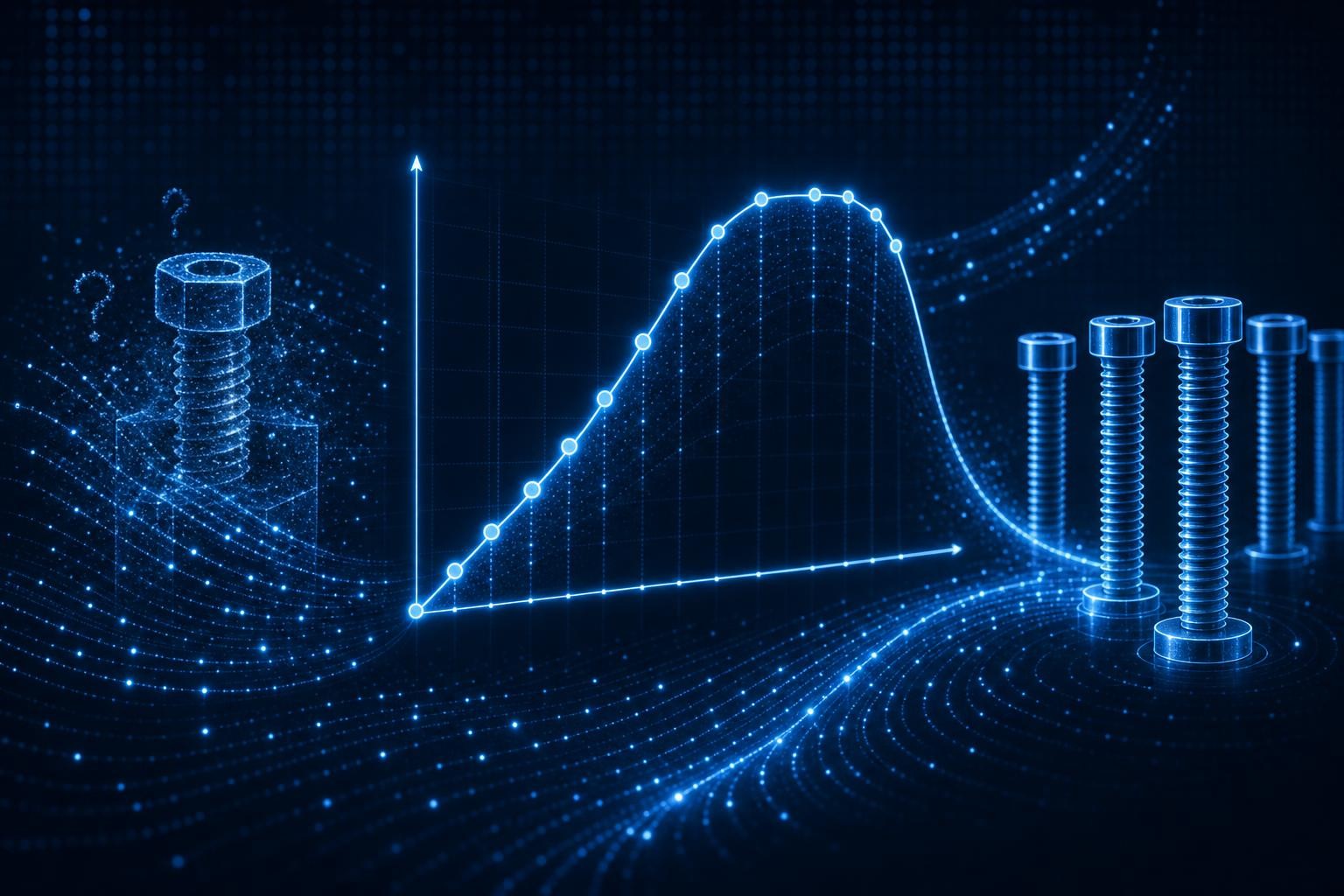
Before a process moves into series production, it must be fully understood. Torque-angle analysis delivers the complete picture of a bolted connection: tightening behavior, friction influences, yield point location, and embedding force behavior become visible - not as a single data point, but as a curve.
The QUANTEC MCS® analysis tool from GWK is designed for exactly this task. Its reference-point-free angle measurement captures torque and rotation angle simultaneously and in real time. The rugged aluminum-titanium construction is built for use under demanding production conditions. The accuracy of ±1% between 10 and 100% of the nominal range ensures that even minor deviations in tightening behavior are detected - relevant, for example, when evaluating locking elements or validating re-tightening processes.
Results can be analyzed and archived directly in QuanLab Pro® - a prerequisite for the complete documentation that certification authorities and auditors in rail vehicle manufacturing require.
Documented Series Assembly: The OPERATOR® in Rail Applications
Analysis alone is not sufficient for series production. Category A bolting cases require guided, documented assembly, in which every single bolting operation is recorded with tool identification, torque value, rotation angle, and timestamp.
The OPERATOR® production tool from GWK meets this requirement. The modular interchangeable-square system enables use across different bolt sizes without tool changes. WLAN data transmission ensures direct integration with upstream quality management systems. For full integration into production lines, the OPERATOR® EST01 is available with PLC communication and Open Protocol.
 AI-generated image
DAkkS Traceability: The Foundation for Certification and Audit
All measurement results are only as reliable as the calibration of the tools used to obtain them. In rail vehicle manufacturing - as in all safety-critical industries - DAkkS traceability is not a nice-to-have; it is a requirement.
GWK operates a DAkkS-accredited calibration laboratory for torque and angle tools. The fully automated DWPM-1000® testing machine calibrates torque and angle wrenches to accuracy class 0.2 - the highest available class for this tool category. For companies that cannot or prefer not to send their tools in for calibration, a mobile calibration service is available.
For companies that only occasionally work on rail vehicle projects or need to cover peak demand, GWK ToolRent® provides calibrated instruments on demand - available weekly, monthly, or annually, with worldwide shipping.
Checklist: Standards-Compliant Bolting in Rail Vehicle Manufacturing
Categorize all bolted connections as A, B, or C per VDI/VDE 2862. Safety-relevant connections (bogie, brake, coupling) are typically Category A. Downward misclassification is a common audit finding.
For Category A connections: perform torque-angle analysis using the QUANTEC MCS®. Document friction coefficients, tightening behavior, and settling losses. Select locking elements per DIN EN 17976 — spring washers are not permitted.
Carry out series assembly using the OPERATOR® production tool. Record every bolted connection with torque, angle, tool ID, and timestamp. For PLC integration: use the OPERATOR® EST01.
After the settling phase has elapsed, perform a residual torque inspection using the Q-CHECK®. Store results without gaps. Define and adhere to inspection intervals.
Calibrate all measurement and assembly tools with DAkkS-traceable calibration. Keep calibration certificates on hand for approval documentation and audits. Use GWK ToolRent® for calibrated rental equipment as needed.
With the entry into force of DIN EN 17976:2025-03, training of personnel involved in bolting operations per VDI/VDE-MT 2637 is mandatory. Document training records for audits.
Conclusion
Bolted connections in rail vehicle manufacturing are not a routine task. Bolted joints in and on rail vehicles are safety-critical - and the requirements reflect that. With DIN EN 17976:2025-03, these requirements have been harmonized and tightened across Europe. Anyone still working to DIN 25201 today is no longer in compliance.
The measurement technology response to these requirements is clearly structured: bolting case analysis with the QUANTEC MCS®, documented series assembly with the OPERATOR®, residual torque audit inspection with the Q-CHECK® - all tools calibrated with DAkkS-traceable accuracy. This is not additional overhead; it is the foundation for a defensible certification documentation package.
Accuracy by GWK.