A forgotten fastener. An incorrect torque setting. A sequence the operator mentally skipped because they were already thinking about the next step. A single improperly tightened screw can affect the performance of an entire system - with real consequences for warranty costs and customer complaints. In series production, this is not an isolated incident; it is a structural risk.
Lean philosophy has a clear answer: errors must not merely be detected - they must be made impossible in the first place. That is the principle behind Poka-Yoke.
What Poka-Yoke Really Means at the Assembly Station
Poka-Yoke is a method used in quality management for manufacturing processes. The term comes from Japanese: "poka" means "inadvertent error" and "yoke" means "prevention" - literally: mistake-proofing. The principle was developed in the 1960s by Japanese engineer Shigeo Shingo and is today a cornerstone of the Toyota Production System and modern Lean concepts.
The principle starts from the premise that no person can work without making mistakes. Technical safeguards must therefore be put in place that either make errors impossible or surface them immediately.
At the assembly station, this means in practice: the tool or guidance system actively prevents a faulty condition from occurring at all - or it blocks the process before a NOK result reaches the next station.
Poka-Yoke ≠ final inspection. A final inspection detects defects — but only after they've already occurred. Poka-Yoke prevents them from occurring in the first place. The difference isn't semantic, it's economic: the later a defect is discovered, the more expensive it is to fix.
Why the Assembly Station Is Especially Prone to Errors
In series-production fastening processes, many factors can compromise process reliability. To ensure that reliability, fasteners, tools, and assembly processes all need to be monitored.
There is also a structural challenge: according to a ManpowerGroup study, the global skilled-labor shortage has reached a 17-year high. The primary drivers are demographic change, early retirement trends, and an increasing number of experienced workers reaching retirement age. In manufacturing in particular, the Baby Boomer generation is now beginning to leave the shop floor.
The result: newer, less experienced operators are taking on complex fastening tasks. Without systematic guidance, error rates rise - not because of carelessness, but because of insufficient process support.
With every additional production stage at which an error goes undetected, the cost of fixing it multiplies tenfold. That says nothing of the reputational damage when an assembly defect is only discovered by the end customer.
The Five Poka-Yoke Mechanisms at the Modern Assembly Station
1. Sequence Control
The correct fastening sequence must be followed, different torque values are required for individual fastening positions, and it must be ensured that no fastener is missed.
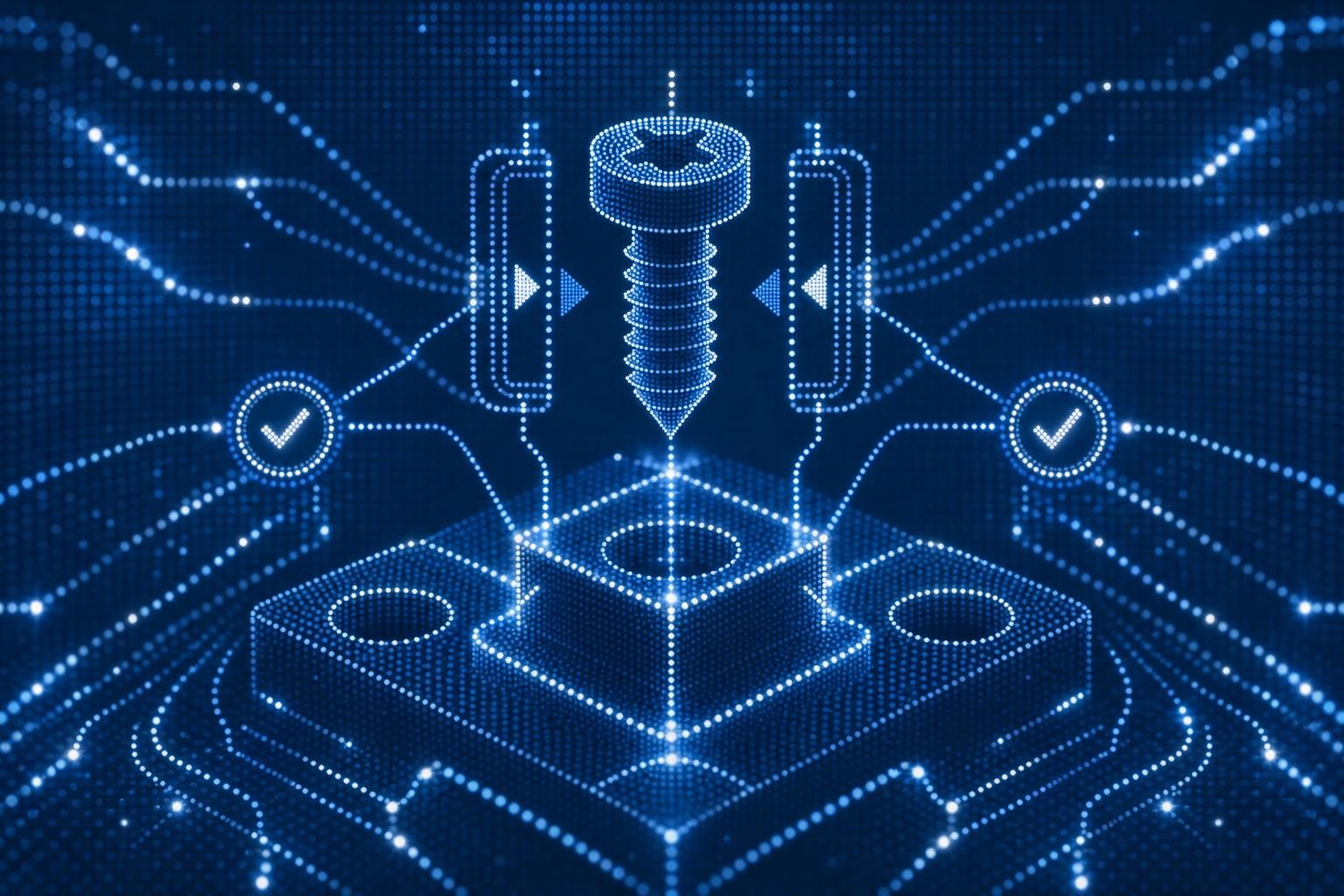
Software-based operator guidance solves this problem by releasing the next step only after the current one has been completed correctly. Only an OK signal from the connected tool triggers the automatic advance to the next work instruction, enabling strict process control.
2. Release Only After an OK Fastening Result
This is the core mechanism of any genuine Poka-Yoke solution at the assembly station: the process does not advance until the result falls within the defined tolerance. Automatic monitoring of every fastening point determines whether the result is OK or NOK. Depending on the fastening result and the configured rule, the operator is shown a different work step.
3. NOK Locking
When a NOK result occurs, the process is actively locked. The operator cannot move on to the next fastener, cannot advance the part to the next station, and cannot leave the workstation. For truly critical fastening joints, at least process reliability Level 4 is required. At this level, it is no longer sufficient to detect all NOK fastenings. Cycle control - simply counting OK fastenings - is not enough either.
4. Audible and Visual Feedback
In addition to 100% documentation of tightening values, it is equally important for process reliability that the operator receives clear, immediate feedback. LEDs on the tool itself serve this purpose. They indicate whether the fastening was within the target values (OK) or is faulty (NOK). Modern fastening electronics offer a wide range of audible and visual feedback options for the operator.
At Rosenbauer, for example, the tool signals the operator in three ways when a fastening has been performed correctly - including an audible click. If the operator has missed a fastener or tightened one twice, they receive an error notification.
5. Digital Step-by-Step Operator Guidance
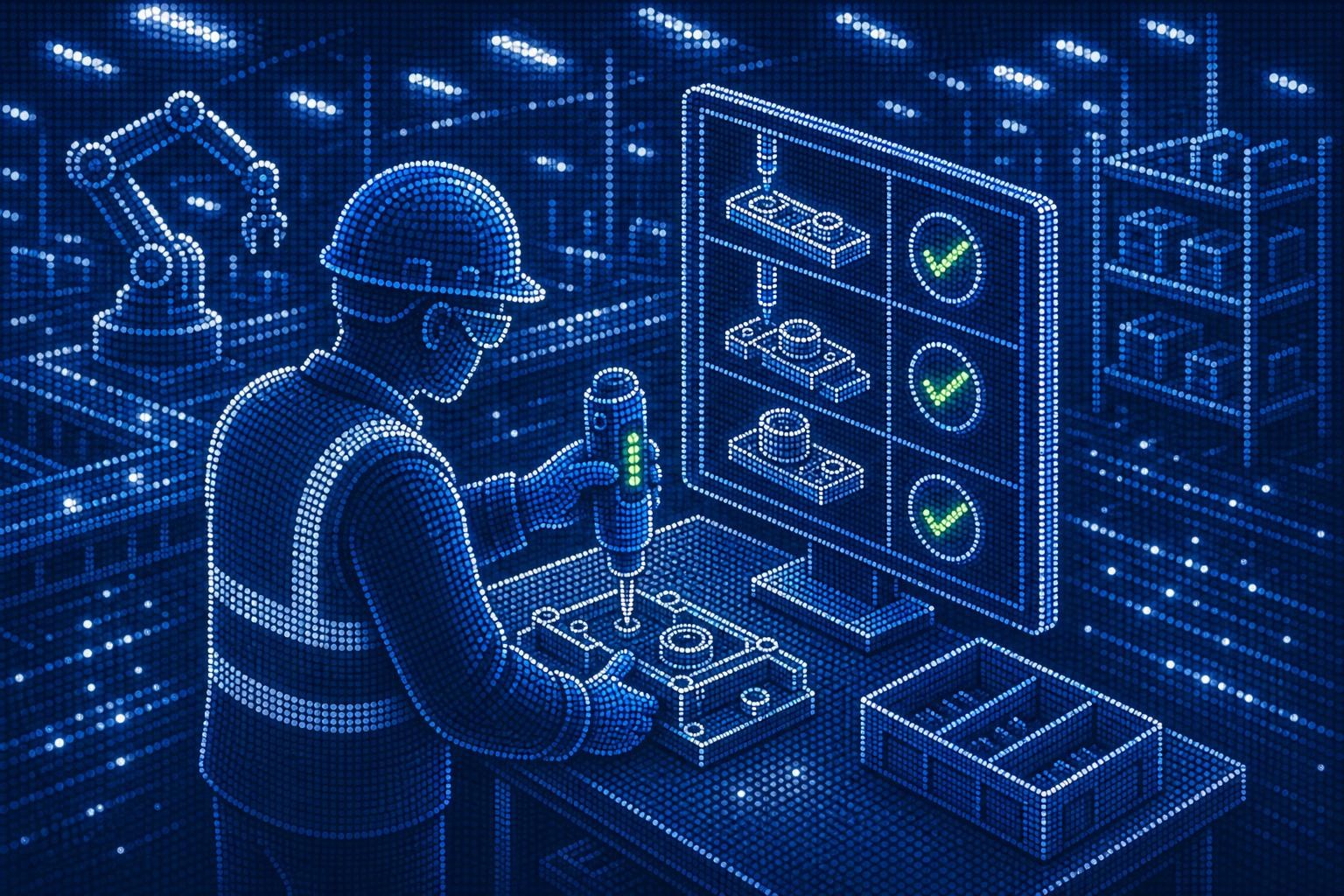
In-process part inspections are no longer necessary when fastening processes are supported by operator guidance, because the inspection is built into the fastening operation itself. The guidance system automatically selects the required parameter set in the fastening controller for the next fastenings, relieving the operator of that task and eliminating the risk of selection errors.
 AI-generated image
Poka-Yoke on the OPERATOR®: What It Looks Like in Practice
The OPERATOR® from GWK is designed as a production tool for exactly this application. Its intuitive user interface guides the operator step by step through the assembly process - without requiring manual parameter selection or reliance on memory for sequence recall.
In practice, the following mechanisms work together:
- Step locking: The next assembly step is only released after an OK signal from the current fastening operation.
- NOK locking: On a NOK result, the system blocks all progress. The operator is directed to rework or escalation - not to the next fastener.
- Audible and visual signals: Green light and signal tone for OK; red signal and lockout for NOK. Unambiguous, with no room for interpretation.
- WLAN data transfer: All fastening data - torque, angle, timestamp, result - is transmitted in real time and archived on a part-specific basis.
- OPERATOR® EST01 with PLC communication: For full integration into higher-level production systems, the EST01 enables direct connection to PLC systems, allowing release signals, line stops, and quality gates to be controlled automatically.
Fully networked assembly enables process-reliable operator guidance. Through a network-integrated human-machine interface, the operator is guided from fastening to fastening and always knows exactly what to do next. In an era of job rotation, that is a significant advantage.
The interchangeable square drive system of the OPERATOR® allows the same base tool to be used at different stations - each with its own stored fastening program. No retooling, no mix-ups, no manual parameter selection.
How This Differs from Final Inspection Alone
Final inspection - whether manual or automated - checks the finished part. It identifies whether something has gone wrong. It does not prevent it.
The idea is straightforward: if an error is possible, the process is not robust enough. There are two types of Poka-Yoke solutions: error prevention (proactive) - where the process is designed so that an error cannot occur in the first place.
| Merkmal | Endkontrolle | Poka-Yoke am Schraubplatz |
|---|---|---|
| Zeitpunkt der Wirkung | Nach der Montage | Während der Montage |
| Fehler verhindern | Nein | Ja |
| Fehler entdecken | Ja (stichprobenartig oder 100 %) | Ja (100 %, in Echtzeit) |
| NIO-Bauteil kann weiterlaufen | Möglich | Nein – aktive Sperre |
| Dokumentation | Separat erforderlich | Automatisch, bauteilbezogen |
| Einarbeitungsaufwand | Hoch (Prüfkompetenz nötig) | Gering (Führung durch System) |
| Eignung bei Fachkräftemangel | Eingeschränkt | Hoch |
Under VDI/VDE 2862, fastening joints are classified into categories A, B, and C based on the risk of failure and the ability to detect and prevent faulty fastenings during assembly. Category A fastening cases carry a risk to human life and the environment in the event of failure. Category B fastening cases present a risk of functional failure.
For Category A joints, final inspection is not sufficient. In cases of product complaints and product liability, manufacturers must be able to demonstrate that they operated in accordance with the current state of the art. Complete, part-specific documentation of every fastening operation is the fundamental prerequisite for this.
Real-World Example: Chassis Assembly with Sequence Control
"Numerous fastenings must be performed in a defined sequence and with a precisely specified torque," explains a production planner. This places a high degree of responsibility on the individual operator for self-monitoring.
That self-monitoring is precisely the problem: it is error-prone, not reproducible, and does not scale with changing workforce compositions. The solution is to shift responsibility from the operator to the system - not to disempower the operator, but to relieve them of that burden.
At the same time, operators can be relieved of a large share of their previous monitoring responsibilities and freed from time-consuming routines. The likelihood of operating errors and incorrectly performed fastenings has been significantly reduced.
Digitizing fastening processes provides a remedy: it guides the user safely through predefined workflows and shortens onboarding times.
Poka-Yoke and the Skilled-Labor Shortage: Two Sides of the Same Solution
The skilled-labor shortage in manufacturing is not a temporary problem. According to the Institute for Employment Research (IAB), the retirement of the Baby Boomer generation will result in seven million fewer skilled workers by 2035. [1]
Poka-Yoke at the assembly station is therefore not only a quality measure - it is a response to the structural shift in the workforce. A system that makes errors impossible is independent of the operator's level of experience. It works just as well for a seasoned specialist as for a newcomer, for a permanent employee as for a temporary worker brought in during peak season.
Users benefit from high process reliability with shorter onboarding times - a decisive factor in digitalized manufacturing.
Conclusion: Process Reliability Starts Before the First Fastener
Poka-Yoke at the assembly station is not an add-on bolted onto an existing process after the fact. It is a design principle: the process is structured so that an error structurally cannot arise - or is immediately detected and locked out before it propagates.
Under VDI/VDE 2862, fastening joints are classified into risk categories A, B, and C, with Category A joints posing a risk to human life and the environment in the event of failure. [2] For these joints, complete documentation and active process safeguarding are not optional - they are mandatory.
The OPERATOR® from GWK combines sequence control, OK-based release, NOK locking, audible-visual feedback, and WLAN data transfer in a single modular production tool. For full system integration, the OPERATOR® EST01 with PLC communication is available. Accuracy by GWK - not as a promise, but as a system property.