The countdown is on. Joby Aviation successfully completed FAA certification Stage 4 in March 2026 - becoming the first eVTOL company in the world to reach this milestone with the US aviation authority. [1] Archer Aviation simultaneously became the first US manufacturer to receive full FAA acceptance of all 797 compliance documents. [2] The industry has reached an inflection point: it's no longer about concepts - it's about demonstrating conformance.
For engineers on the assembly floor, this has an immediate consequence: every fastened joint installed in a certification-required aircraft must be fully documented, traceable, and backed by measurement data - from the very first pilot build through ramp-up to multiple units per month.
The Ramp-Up: From One-Offs to Small-Series Under Certification Pressure
Joby plans to scale its manufacturing capacity in Marina, California, to four aircraft per month by 2027. [2] Archer is simultaneously building six conformance aircraft in parallel, three of them in final assembly. [3] Those sound like small numbers - and that's precisely the challenge.
In the automotive industry, quality processes are designed around thousands of units per day. In the eVTOL ramp-up, we're talking about dozens to a few hundred aircraft per year - with aerospace-grade requirements at every single fastening point. [4] puts it precisely: "Producing it repeatedly, affordably and at aerospace-grade quality is the one that will determine scale."
The FAA requires that all calibration and inspection standards for measuring equipment be traceable to an authority-recognized standard. [5] This applies to every torque and angle tool used on a certification-required component - without exception.
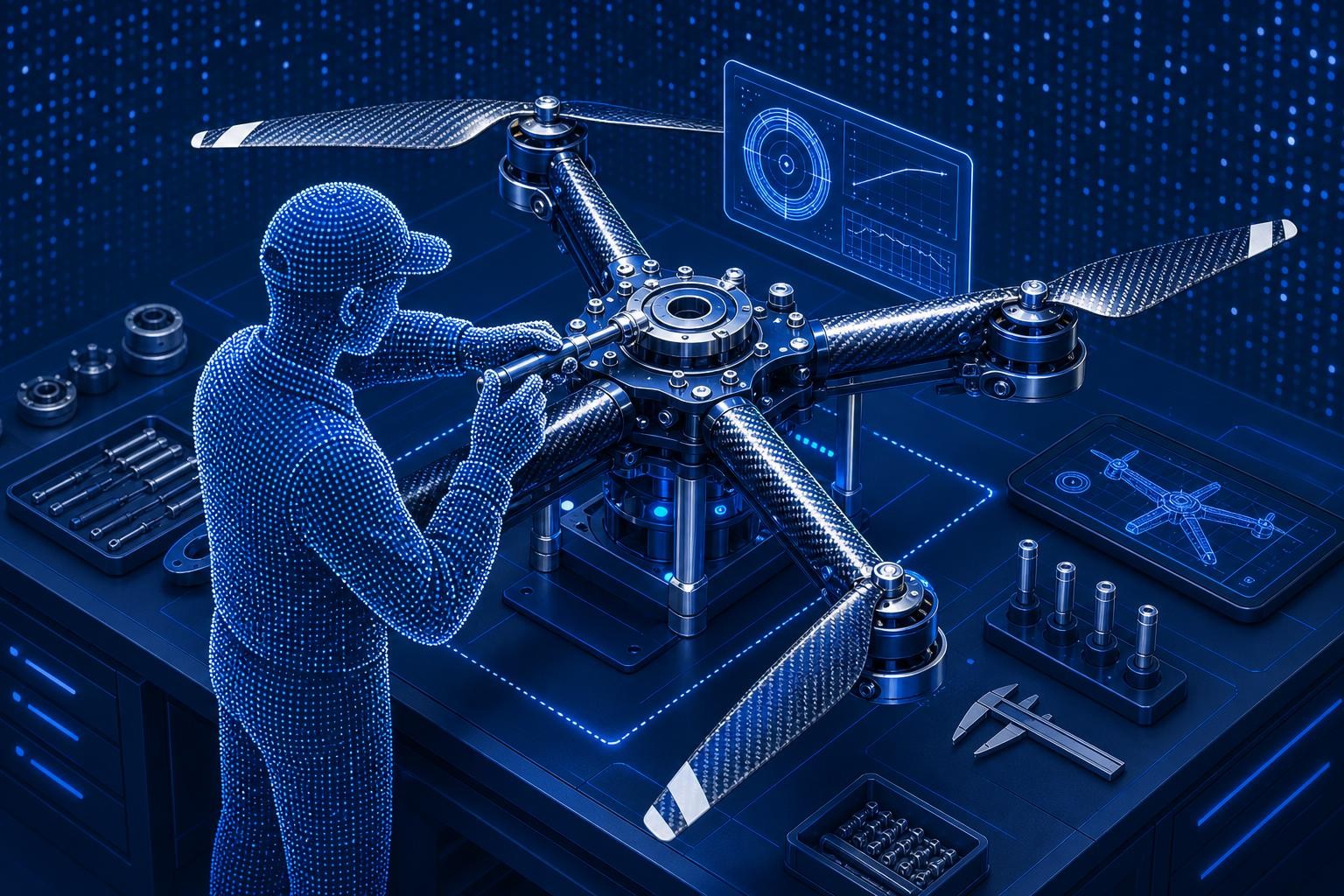 AI-generated image
Five Fastening Requirements That Set eVTOL Apart From Other Industries
1. Extreme Lightweight Design - Every Gram Counts
Titanium fasteners are increasingly used in eVTOL structures because their superior strength-to-weight ratio directly affects range and payload capacity. [6] Titanium fasteners are highly sensitive to overtorque: too much torque causes plastic deformation; too little results in insufficient clamp load. The tolerance window is tighter than in almost any other industry.
Torque alone isn't enough here. Only the combined measurement of torque and angle provides a reliable indication of the actual clamp force in the joint - independent of friction variations in the thread or at the bearing surface.
2. Vibration as a Continuous Load
Components such as Hi-Lok pins and swaged lockbolts are used in highly loaded areas like wing-to-fuselage joints to prevent motor-induced loosening caused by vibration. [6] An eVTOL drivetrain with six or more electric motors generates a complex vibration spectrum across the entire operating range. Joints that were correctly torqued in static testing can critically relax under dynamic load - if the clamp force was not precisely documented from the start.
3. Safety-Critical Joints With No Redundancy Through Mass
In automotive manufacturing, uncertainties in fastening assembly are offset by redundancy: multiple joints, thicker wall sections, higher safety factors. In lightweight eVTOL design, that margin simply doesn't exist. Every joint carries its function on its own. This makes the process capability of the fastening assembly - measurable per VDI/VDE 2645 - a certification-relevant criterion.
4. Low-to-Mid Volumes With High-Volume Documentation Requirements
The FAA requires conformance evidence at the individual part level. [1] describes Stage 4 of certification as proof that the physical hardware matches the certified design exactly - joint by joint. This demands a documentation infrastructure that works flawlessly even at ten aircraft per month.
5. Traceability as a Prerequisite for Certification
Every fastened joint must be traceable to a specific tool, operator, timestamp, and calibration status. If a single data point is missing, the conformance of the component cannot be demonstrated - and certification is at risk.
FAA certification of an eVTOL requires proof that every safety-critical fastener was tightened using a calibrated, traceable tool. An undocumented torque operation is, in the context of type approval, equivalent to an operation that was never performed.
QUANTEC MCS®: The Compact Fastening Lab for eVTOL Assembly
GWK's QUANTEC MCS® analysis tool was developed for exactly this combination of requirements. Its reference-point-free angle measurement captures the rotation angle independently of a defined starting point - a decisive advantage for joints where the tightening sequence doesn't begin at a reproducible position, as is frequently the case with titanium fasteners exhibiting variable friction behavior.
Key technical specifications that matter in the eVTOL context:
- Measurement accuracy of ±1% between 10 and 100% of the nominal range - sufficient for the tightest tolerance windows in lightweight fastening applications
- Robust aluminum-titanium construction for use in manufacturing environments subject to mechanical stress
- Wi-Fi data transfer for direct integration with quality management systems such as QuanLab Pro®, Ceus, or QS-Torque
- Modular design with individually replaceable components - easy to maintain even at low volumes without a dedicated tool shop
For process capability studies (PCS) per VDI/VDE 2645-3 - a standard requirement in aerospace quality assurance - the Q-CHECK® rounds out the portfolio as a QA and audit tool, with a measurement range of 3 to 1,000 Nm and 2 GB of internal storage.
ToolRent®: Flexibility for the Ramp-Up Without Tying Up Capital
The production ramp-up of an eVTOL manufacturer rarely follows a straight line. Certification phases, rework loops, parallel test programs at multiple locations across different states - [2] - all demand tool availability at changing sites and changing times.
GWK ToolRent® addresses exactly this problem: calibrated precision tools on demand, available on weekly, monthly, or annual rental terms with worldwide shipping. For eVTOL manufacturers and their Tier 1 suppliers, this means:
- No capital tied up during the ramp-up phase, when unit volumes are still low and cash flows are negative
- Immediate availability of calibrated instruments for new assembly sites or rework stations
- Complete calibration history - every rental unit arrives with a current DAkkS-compliant calibration certificate
- Scalability without lead time: as production rates increase, so does the tool count - no procurement process required
The Certification Context: What the FAA Actually Audits
The FAA regulates eVTOL operations under a Special Federal Aviation Regulation (SFAR) published in 2024, which establishes a combined framework drawing on both fixed-wing and rotorcraft rules for powered-lift aircraft. [7] In July 2025, the FAA published additional guidance on type, production, and airworthiness certification for powered-lift aircraft.
What this means for fastening assembly: the conformance review in Stage 4 - which Joby completed in March 2026 as the first manufacturer to do so - requires proof that the physical hardware matches the certified design exactly. [1] describes it this way: the FAA explicitly validated the reliability of the propulsion system and fly-by-wire redundancy - two of the most technically contested elements of the certification plan.
For suppliers and assembly contractors, this means: any organization manufacturing assemblies for certification-required eVTOL structures must document its fastening processes in a way that holds up under an FAA conformance review. This is not a theoretical risk - it is the entry ticket to the supply chain.
From Prototype to Series: The Three Critical Phases of Fastening Technology
During the development phase, tightening parameters are determined for new joint concepts. The QUANTEC MCS® analysis tool captures torque-angle curves in real time and identifies the optimal tightening window — even for novel titanium joints with unknown friction behavior. The result: validated tightening parameters that serve as the basis for the certification application.
Before production launch, the process capability of the bolting assembly must be demonstrated. The Q-CHECK® enables residual torque measurements for process capability studies (PFU) in accordance with VDI/VDE 2645-3. Measurement data is stored on 2 GB of internal memory and can be exported directly for use in certification documentation.
During production ramp-up, the OPERATOR® EST01 with PLC communication and Open Protocol handles integration with the production system. Every tightening operation is archived with a timestamp, tool ID, and calibration status. The square drive adapter system enables fast tool changes without recalibration — critical for small batch sizes with many different joint types.
Conclusion: Fastening Technology Is Not a Side Issue in the eVTOL Ramp-Up
The global eVTOL market was valued at $14.3 billion at the end of 2025. [8] According to industry analysts, the companies that will survive in this market are those with strong industrial partners and the commitment to implement quality standards consistently. [9]
In this context, precision fastening is not a cost factor - it is a competitive advantage. Organizations that build the documentation infrastructure for FAA-compliant fastening processes today will shorten certification cycles, reduce rework costs, and position themselves as reliable suppliers in an industry where trust is the hardest currency of all.
GWK provides the tools to make that happen - precise, traceable, and flexibly scalable. Accuracy by GWK.
What torque ranges are typical for eVTOL joints?
eVTOL structures span a wide spectrum: from miniature fasteners on avionics brackets (under 5 Nm) to rotor hub joints (20–80 Nm) and primary structural connections (100–200 Nm). The QUANTEC MCS Multibox® covers 1.2–200 Nm, and the Q-CHECK® covers 3–1,000 Nm — both with ±1% accuracy between 10 and 100% of the nominal range.
Why is torque control alone insufficient for aerospace joints?
Torque is an indirect measure of clamp load. Friction variations in the thread — especially with titanium fasteners — can cause clamp load deviations of ±25% at the same tightening torque (NASA reference value for hand-operated torque wrenches). The combined torque-angle measurement with reference-point-free angle detection provides a significantly more reliable indication of the actual clamp load range.
How does GWK ToolRent® work for international eVTOL test programs?
GWK ToolRent® offers weekly, monthly, or annual rental with worldwide shipping. Every rental unit is delivered calibrated and comes with a complete calibration history. For manufacturers running test programs across multiple states or countries simultaneously — like Joby — this enables on-demand tool availability without tying up capital.
What is reference-point-free angle measurement?
With conventional angle-tightening tools, the angle is measured from a defined starting point (e.g., when a minimum torque threshold is reached). The reference-point-free angle measurement of the QUANTEC MCS® captures the angle independently of any such reference point — enabling a more precise analysis of the entire tightening curve, which is especially advantageous for joints with variable friction behavior.
Which standards are relevant for bolted joint assembly in eVTOL structures?
In addition to FAA requirements (14 CFR Part 21, production conformity), European manufacturers must also consider EASA CS-23/CS-27 as well as VDI/VDE 2645-3 for process capability studies. DAkkS-accredited calibration by GWK ensures that all measuring equipment is traceable to national and international standards.