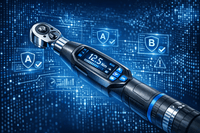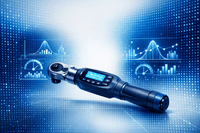

Imagine an auditor shows up on your production floor tomorrow morning and asks for the MFU report for your Category A torque tools. Can you produce it in two minutes-or will you still be digging through five different folders?
Audits in torque-controlled assembly are becoming more demanding. Whether it is an IATF 16949 audit in the automotive sector, EN 9100 in aerospace, or a customer audit from a Tier 1 supplier: auditors know exactly where the weak points usually are-and they look for them systematically. Missing calibration certificates, incomplete evidence of process capability, or undocumented NOK (not OK) processes are classic findings that lead to expensive rework, production holds, or even loss of certification.
This article provides a field-tested audit checklist with 10 inspection items that auditors regularly scrutinize. For each item you will learn what the auditor specifically expects to see, where typical weaknesses lie, and how you can systematically protect yourself.
This checklist does not replace an official audit, but it provides you with practical, field-tested guidance on which evidence and documentation an experienced auditor typically requires when auditing your screw-fastening processes — whether for IATF 16949, EN 9100, or a customer audit.
The 10 Inspection Items in Detail
Item 1: Fastening Case Classification According to VDI/VDE 2862
What the auditor wants to see: A complete, up-to-date list of all fastening cases in your assembly-classified as Category A (safety critical), Category B (function critical), and Category C (non-critical) according to VDI/VDE 2862.
Typical weakness: The classification was performed once but never updated, even though components, designs, or safety requirements have changed. Or: new fastening points were introduced but never classified.
How to protect yourself:
- Maintain a fastening case matrix with component reference, category, date of last review, and responsible person.
- Define a process that automatically triggers a reassessment whenever design changes occur.
- The classification is the foundation for all further requirements-this is where you should invest particular care.
Item 2: Tool Qualification
What the auditor wants to see: Evidence that the torque tool used for each fastening case class is technically suitable and released. For Category A fastenings this means: torque and angle measurement, defined tolerance monitoring, and automatic shut-off control.
Typical weakness: A simple torque wrench without angle measurement is used for Category A fastening cases-a clear finding.
How to protect yourself:
- Document the approved torque tools for every fastening point, including model designation and serial number.
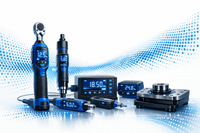
- Ensure that Category A joints are processed with torque tools that monitor both torque and angle-for example, the modular OPERATOR® production tools from GWK with their patented square system, ideal for advanced torque control and torque analysis.
Item 3: Calibration Evidence
What the auditor wants to see: Current, valid calibration certificates for every torque tool used in the process-with expiry date, test laboratory name, and, for higher requirements, the DAkkS accreditation mark from a DAkkS accredited calibration laboratory.
Calibration certificates or test reports must bear the accreditation mark of the national accreditation body in order to demonstrate traceability to national standards.
Typical weakness: Expired certificates, calibrations performed by non-accredited labs, or missing traceability to national standards. Particularly critical: the torque tool was repaired in the meantime but not recalibrated afterwards.
How to protect yourself:
- Operate a digital calibration calendar system that automatically reminds you of upcoming due dates.
- For Category A and B applications, rely on DAkkS-accredited calibration. GWK's own DAkkS calibration laboratory (DAkkS accredited calibration laboratory) offers class 0.2 measurement accuracy-also as a mobile service directly on your production line to minimize downtime.
- GWK's Q-CHECK® calibration devices also enable quick internal intermediate checks between calibration cycles, so you can detect deviations at an early stage.
Item 4: Machine Capability (MFU)
What the auditor wants to see: Current MFU (machine capability) reports according to VDI/VDE 2645-2 for all tools requiring qualification-with statistical indicators such as Cm and Cmk values.
The machine capability study (MFU) determines indicators for stability and reproducibility of the process influence factor "machine" and ensures that only suitable torque tools are used.
The required minimum Cmk value is Cm/Cmk ≥ 1.67 for torque tools in Category A and B applications.
Typical weakness: MFU was only performed once during commissioning and never repeated. Or: the study was carried out under idealized laboratory conditions and does not reflect real production conditions.
How to protect yourself:
- Define repeat intervals for MFU (e.g., every six months or after maintenance/repair).
- With the QUANTEC MCS® analysis tool from GWK, you can perform MFUs directly on the assembly line. Its patented angle sensor technology provides precise Cm/Cmk evaluations that can be exported instantly into professional MFU reports-an essential building block of robust assembly inspection and assembly quality assurance.
Item 5: Process Capability (PFU)
What the auditor wants to see: Regular PFU (process capability) evaluations according to VDI/VDE 2645-3 with documented Cp and Cpk values-as proof that not only the torque tool but the entire fastening process is under control under real conditions.
While MFU examines the capability of the torque tool in isolation, PFU evaluates the complete process under real manufacturing influences-including people, material, method, and environment.
Typical weakness: PFU is confused or equated with MFU. Many plants have MFU reports but no independent PFU evidence.
How to protect yourself:
- Conduct PFUs at defined intervals-at least once a year and immediately after process changes.
- The Quantec MCS® system supports data collection for PFU: WLAN data transmission, automatic logging, and export functions for statistical evaluation using Ceus or QS-Torque software. This makes it an ideal angle torque meter and torque control platform for continuous process capability monitoring.
Item 6: Torque Documentation
What the auditor wants to see: A complete, tamper-proof record of all torque values-including timestamp, tool identification, and component reference.
Typical weakness: Paper-based documentation with illegible entries, missing timestamps, or unclear assignment to components. Or: data is captured but not archived.
How to protect yourself:
- Digital torque tools with automatic data storage eliminate input errors and gaps.
- The OPERATOR® from GWK transmits all fastening data via WLAN in real time and stores it with timestamp, parameters, and tool ID-always ready as evidence for your audit checklist.
- Make sure your archiving periods comply with the standard requirements (IATF 16949 typically requires 15 years for safety-critical joints).
Item 7: Angle Documentation
What the auditor wants to see: For Category A fastenings, not only the torque value but also the angle of rotation-fully captured and documented.
Whenever an angle-controlled tightening procedure is used, a capability study must be provided for this method.
Typical weakness: Torque is recorded, but angle is not-even though the tightening strategy (e.g., yield point control) defines angle as a critical control variable.
How to protect yourself:
- For each Category A fastening point, check whether the tightening strategy requires angle measurement.
- QUANTEC MCS®, with its patented angle sensor technology, records torque and angle simultaneously and seamlessly-including full tightening curves for later torque analysis.
Item 8: Traceability (Production Traceability)
What the auditor wants to see: The ability to clearly assign every fastening operation to a specific component or serial number-and to prove this assignment afterwards.
Typical weakness: Fastening data is recorded but only with shift date and tool number-no component reference. In the event of a recall, it is almost impossible to narrow down the affected parts.
How to protect yourself:
- Integrate barcode or RFID readers into your fastening process to identify components automatically.
- The OPERATOR® from GWK supports optional barcode readers and can be seamlessly integrated into higher-level MES or ERP systems via Open Protocol and PLC interfaces-creating robust production traceability.
- Define: Which data must be archived? Who has access? For how long?
Item 9: Training Records
What the auditor wants to see: Documented proof that all operators using torque tools are demonstrably trained and qualified for their tasks.
All activities related to fastening processes must be carried out by demonstrably qualified personnel.
Typical weakness: Training sessions took place, but there are no training records or attendance lists. Or: new employees were trained on the job, but this was not documented.
How to protect yourself:
- Maintain a training matrix that shows, for every operator: Which torque tools and procedures are they authorized for? When was the last training completed? When is the next one due?
- Keep training records that include date, content, trainer, and the participant's signature.
Item 10: Error Management (NOK Process)
What the auditor wants to see: A documented, binding process for cases where a fastening is evaluated as NOK (not OK)-with clear rules for blocking, rework, and escalation.
Typical weakness: Informal rules exist ("the shift supervisor takes care of it"), but there is no written work instruction. During the audit, it is then impossible to prove what happened to a NOK component.
How to protect yourself:
- Define in writing: What qualifies as NOK? Who decides on release, blocking, or rework? How is this documented?
- Ensure that NOK events are archived in a traceable manner-including the actions taken and the final report.
- Digital torque tools like the OPERATOR® can automatically flag NOK fastening cases and trigger a rework request before the component leaves the station.
Requirements by Fastening Category: At a Glance
Not all 10 inspection items apply with the same level of obligation to every fastening category. The table below summarizes what VDI/VDE 2862 requires:
| Requirement | Category A (safety-critical) | Category B (functional-critical) | Category C (non-critical) |
|---|---|---|---|
| Screw joint classification documented | ✅ Mandatory | ✅ Mandatory | ✅ Mandatory |
| Tool qualification (MFU) | ✅ Mandatory (Cm/Cmk ≥ 1.67) | ✅ Mandatory (Cm/Cmk ≥ 1.67) | ⚠️ Recommended |
| DAkkS-accredited calibration | ✅ Mandatory | ✅ Mandatory | ⚠️ Recommended |
| Process capability study (PFU) | ✅ Mandatory (Cp/Cpk ≥ 1.67) | ✅ Mandatory (Cp/Cpk ≥ 1.67) | ❌ Not required |
| Torque value documentation | ✅ Complete | ✅ Complete | ⚠️ Sample-based |
| Rotation angle documentation | ✅ Mandatory | ⚠️ Context-dependent | ❌ Not required |
| Traceability (part-to-component assignment) | ✅ Mandatory | ⚠️ Recommended | ❌ Not required |
| Operator training certificate | ✅ Mandatory | ✅ Mandatory | ⚠️ Recommended |
| NOK process defined | ✅ Mandatory | ✅ Mandatory | ⚠️ Recommended |
Test Your Audit Readiness
How well prepared are you for the next audit? Answer the 10 questions in our interactive self-check and get an immediate assessment of your audit readiness:
Why Digital Torque Tools Make the Audit Difference
A common thread runs through all 10 inspection items: documentation, documentation, documentation. An auditor can only assess what can be proven. This is exactly where digital precision torque tools have a structural advantage over analog solutions.
Manual documentation entails three classic risks:
- Human input errors (wrong values, missed entries)
- Media breaks (paper -> Excel -> database) with transfer errors
- Missing or incomplete timestamps and component assignment
The GWK torque tool system addresses these risks systematically and strengthens your assembly inspection and assembly quality assurance:
| Inspection item | GWK solution |
|---|---|
| Calibration evidence (Item 3) | DAkkS-accredited GWK laboratory, class 0.2 - stationary & mobile on site |
| MFU & PFU (Items 4 & 5) | Quantec MCS® with patented angle sensor technology & software export |
| Torque values (Item 6) | OPERATOR® with automatic WLAN data storage and timestamp |
| Angle values (Item 7) | Quantec MCS® records complete tightening curves including angle |
| Traceability (Item 8) | OPERATOR® with barcode integration & MES/ERP interfaces |
| Internal calibration devices (Item 3) | Q-CHECK® for fast internal intermediate checks |
For companies that do not have a permanent need for high-precision torque control and torque analysis tools, or that need to act at short notice before an audit, GWK offers a flexible alternative with its ToolRent® rental system: calibrated Quantec MCS®, Q-CHECK®, and OPERATOR® devices on demand-without investment costs.
The 5 Most Common Audit Findings in Torque-Controlled Assembly
Our day-to-day experience shows the same findings again and again. Prepare for them specifically:
- Expired calibration certificates - the most frequent and easiest finding to avoid
- Missing MFU reports after tool repair or tool change
- Incomplete angle documentation for Category A fastenings
- Non-verifiable traceability - fastening data without component reference
- Missing written NOK process - error management not documented in a controlled way
Conclusion: Preparation Beats Improvisation
An audit in the field of torque-controlled assembly should never come as a surprise-the inspection items are known, and the standards are clear. The real differentiator is the consistency and systematics with which you document and maintain your processes.
Work through these 10 items as an internal audit checklist before the auditor arrives. Identify gaps in a targeted way and close them-ideally with torque tools and systems that make documentation an automatic outcome of the fastening operation, rather than an additional manual task.
Together, we can develop the optimal solution for your specific audit requirements-from DAkkS-accredited calibration via MFU/PFU support with Quantec MCS all the way to integrated documentation systems for full production traceability. Made in Germany. Engineering with passion.
FAQ: Frequently Asked Questions About Audit Preparation in Torque-Controlled Assembly
How often must screw tools be calibrated?
Calibration frequency depends on the screw joint class and the level of usage. VDI/VDE 2862 requires regular calibration for category A- and B-fastening joints. In practice, intervals of 6 to 12 months have proven effective. The key is: The certificate must be valid at the time of the audit and issued by an accredited laboratory (ideally DAkkS).
What is the difference between MFU and PFU?
Machine Capability Investigation (MFU) according to VDI/VDE 2645-2 tests the tool itself under laboratory conditions - independent of the actual screw joint. It provides Cm/Cmk values. The Process Capability Investigation (PFU) according to VDI/VDE 2645-3, on the other hand, evaluates the entire screwing process under real manufacturing conditions and provides Cp/Cpk values. In audits, typically both are required - the MFU as tool evidence, the PFU as process evidence.
Which documents do I need to present at the audit?
An auditor typically expects: (1) screw joint classification list according to VDI/VDE 2862, (2) current calibration certificates for all tools used, (3) MFU protocols with Cm/Cmk values, (4) PFU evaluations with Cp/Cpk values, (5) torque and angle records with part/assembly mapping, (6) training records for operators, and (7) a documented NOK process.
Does VDI/VDE 2862 apply only to the automotive industry?
Originally, VDI/VDE 2862 was developed for the automotive industry. Today the guideline is also used as a reference standard in aerospace (EN 9100), mechanical engineering, and other safety-critical industries. Customer audits outside the automotive world increasingly align with the same test principles.
What happens if my tool does not meet the MFU threshold values?
If a tool does not reach the required Cm/Cmk values of at least 1.67, it may no longer be used for the affected screw joints until the cause is addressed. Typical measures are: calibration, maintenance, or replacement of the tool. All parts produced with this tool since the last successful MFU must be inspected or blocked.